Event submissions
Published
This submission belongs to the session G. Food Safety, Toxicology & Quality of the event The 7th International Electronic Conference on Foods
Published date
23 Oct, 2026
Academic Editor
 Esther Sendra
Citation
Diogo Lucas Pinheiro, Patrícia Bernardo, Cátia Morgado, Mafalda Alexandra Silva, Helena S. Costa, Carlos Brandão, Tânia Gonçalves Albuquerque, Optimizing fermentation time to improve the safety and quality of a Portuguese-style fish sausage, in Proceedings of The 7th International Electronic Conference on Foods, 28 October–30 October 2026, MDPI: Basel, Switzerland
Share
Email
Facebook
Twitter
LinkedIn
Optimizing fermentation time to improve the safety and quality of a Portuguese-style fish sausage

Diogo Lucas Pinheiro 1
Patrícia Bernardo 1,2
Cátia Morgado 1,3
Mafalda Alexandra Silva 4,5

Helena S. Costa 4,5
Carlos Brandão 1,3

Tânia Gonçalves Albuquerque 1,5
1. Department of Health, Science and Food Technology, Estoril Higher Institute for Tourism and Hotel Studies, Estoril, 2769-510, Portugal
2. Center for Interdisciplinary Research in Animal Health (CIISA) Faculty of Veterinary Medicine, University of Lisbon, Lisbon, 1300-477, Portugal
3. Centre for Tourism Research, Development and Innovation (CiTUR), Estoril, 2769-510, Portugal
4. Department of Food and Nutrition, National Institute of Health Dr. Ricardo Jorge, Lisbon, 1649-016, Portugal
5. REQUIMTE-LAQV/Faculty of Pharmacy, University of Porto, Porto, 4050-313, Portugal
Abstract
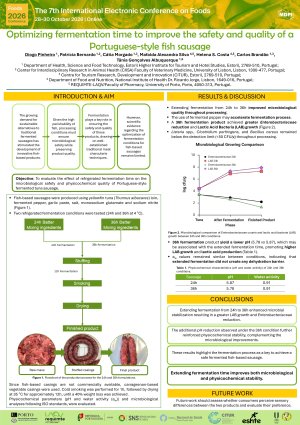
Introduction: The growing demand for sustainable alternatives to traditional fermented sausages has stimulated the development of fish-based products. Since fish is highly perishable raw material, processing conditions must ensure microbiological safety while preserving product quality. Fermentation is a key step in achieving these objectives; however, information regarding the optimization of fermentation conditions for fish-based sausages remains limited. This study evaluated the effect of refrigerated fermentation time on the microbiological safety and physicochemical quality of a Portuguese-style fermented tuna sausage.
Methods: Experimental sausages were prepared using yellowfin tuna (Thunnus albacares) loin, fermented pepper, garlic paste, salt, monosodium glutamate, and sodium nitrite. Two refrigerated fermentation conditions were tested (24h and 36h at 4°C), followed by stuffing into vegetable casings, cold smoking, and dehydration until approximately 40% weight loss was achieved. Physicochemical parameters (pH and water activity, aw) and microbiological analyses follow ISO standards.
Results: Extending fermentation from 24h to 36h improved microbiological quality throughout processing. Enterobacteriaceae counts decreased by 0.8 log CFU/g after 36 h of fermentation compared with 0.4 log CFU/g after 24h, with final reductions of 2.1 and 1.2 log CFU/g, respectively. Lactic acid bacteria increased by 2.9 log CFU/g after 36 h of fermentation and by 3.5 log CFU/g in the final product, compared with increases of 2.5 and 2.9 log CFU/g under the 24h condition. Listeria spp., Clostridium perfringens, and Bacillus cereus remained below the detection limit (<50 CFU/g) throughout processing. Final products exhibited similar aw values (0.91), whereas pH was slightly lower after 36h of fermentation (5.78) than after 24h (5.87).
Conclusions: Extending refrigerated fermentation from 24h to 36h enhanced microbial stabilization, promoting greater growth of lactic acid bacteria and improved reduction of Enterobacteriaceae without adversely affecting physicochemical characteristics. These findings highlight fermentation time as a critical processing parameter to produce safe and high-quality fermented fish sausages.
Keywords
Fish fermented sausage
Fermentation
Tuna
Food safety
Sustainable protein
Poster
Poster Foods 24vs36.pdf
Influence of Processing Operations on the Functional and Rheological Properties of Legume Flours
Impact of Mild Oven Drying on Colour Preservation and Phenolic Extractability of Mentha spicata L. from the Saloia Region