Event submissions
Published
This submission belongs to the session C. Food Physicochemistry & Analysis of the event The 7th International Electronic Conference on Foods
Published date
23 Oct, 2026
Academic Editor
 Joana S. Amaral
Citation
Paulo Henrique Fonseca, Maria Lurdes Felsner, Response Surface Optimization of Digital Image Colorimetry for Total Acidity Determination in Alcohol Vinegar, in Proceedings of The 7th International Electronic Conference on Foods, 28 October–30 October 2026, MDPI: Basel, Switzerland
Share
Email
Facebook
Twitter
LinkedIn
Response Surface Optimization of Digital Image Colorimetry for Total Acidity Determination in Alcohol Vinegar

Paulo Henrique Fonseca 1

Maria Lurdes Felsner 1
1. Chemistry Department, State University of Londrina, 86057-970, Londrina city, Brazil
Abstract
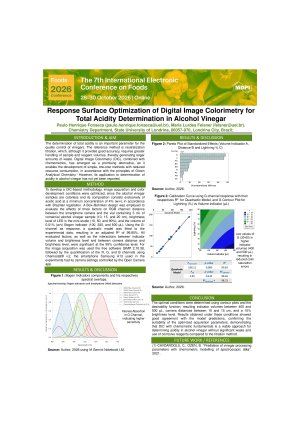
Alcohol vinegars are used in food preparation and as ingredients in the food industry. Therefore, their acidity must be controlled to ensure product quality. Digital image colorimetry (DIC) has gained attention due to its low-cost instrumentation, rapid analysis, and agreement with Green Analytical Chemistry. However, its application to determination of acidity in alcohol vinegar has not yet been reported. To develop a DIC-based methodology, image acquisition and color development conditions were optimized, since the alcohol vinegar samples are colorless and its composition consists exclusively of acetic acid at a minimum concentration of 4% (w/v), in accordance with Brazilian legislation, and shall not exceed 1% (v/v) residual ethanol derived from the alcoholic fermentation involved in vinegar production. A Box–Behnken design was employed to evaluate the effects of three factors on RGB channel: distance between the smartphone camera and the vial containing 3 mL of comercial alcohol vinegar sample (10, 15, and 20 cm), brightness level of LED in the mini-studio (10, 50, and 90%), and the volume of 0.01% (w/v) Bogen indicator (100, 300, and 500 μL). Using the G-channel as response, a quadratic model was fitted to the experimental data, resulting in an adjusted R² of 99.85%. All evaluated factors, as well as the interactions between indicator volume and brightness level and between camera distance and brightness level, were significant at the 95% confidence level. The optimal conditions were determined using contour plots and the desirability function, resulting indicator volumes between 400 and 500 μL, camera distances between 10 and 15 cm, and a 10% brightness level. Results obtained under these conditions showed good agreement with the model predictions, confirming the suitability of the optimized acquisition parameters, demonstrating that DIC is a viable approach for determining acidity in alcohol vinegar without significant waste and use of corrosive reagents.
Keywords
Alcohol Vinegar
Smartphone
Green Chemistry
Total Acidity.
Poster
Poster FOODS Paulo Henrique Fonseca.pdf
Impact of Mild Oven Drying on Colour Preservation and Phenolic Extractability of Mentha spicata L. from the Saloia Region
Assessment of Petiveria alliacea L. Extract on the Shelf life and Residue Analysis of Solanum lycopersicum L. fruits.