Event submissions
Published
This submission belongs to the session C. Food Physicochemistry & Analysis of the event The 7th International Electronic Conference on Foods
Published date
23 Oct, 2026
Academic Editor
 Joana S. Amaral
Citation
Menalda V. André, Catarina Prista, Teresa J. S. Matos, Vitor D. Alves, Effect of Wet Ageing on the Proximal Composition and Mineral Profile of Meat from Adult Serpentina Goats, in Proceedings of The 7th International Electronic Conference on Foods, 28 October–30 October 2026, MDPI: Basel, Switzerland
Share
Email
Facebook
Twitter
LinkedIn
Effect of Wet Ageing on the Proximal Composition and Mineral Profile of Meat from Adult Serpentina Goats

Menalda V. André 1,2
Catarina Prista 1,3
Teresa J. S. Matos 1

Vitor D. Alves 1,3
1. LEAF – Linking Landscape, Environment, Agriculture and Food Research Centre, Instituto Superior de Agronomia, Universidade de Lisboa, Tapada da Ajuda, Lisboa, 1349-017, Portugal
2. Faculdade de Ciências de Saúde, Universidade Lúrio, Campus Universitário de Marrere, Nampula 4250, Mozambique
3. Associate Laboratory TERRA, Instituto Superior de Agronomia, Universidade de Lisboa, Tapada da Ajuda, Lisboa, 1349-017, Portugal
Abstract
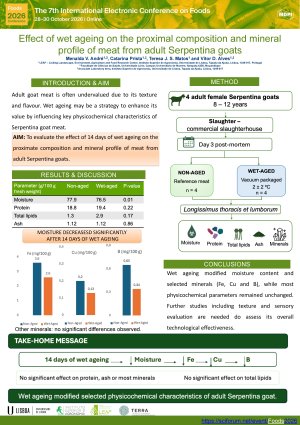
Goat meat from adult animals is frequently undervalued because of its lower tenderness and more intense flavor. Wet ageing may represent a suitable technological strategy for increasing the value of this product, particularly in autochthonous breeds such as Serpentina, which are important for the preservation of local genetic resources and the sustainability of rural food systems. This study evaluated the effect of 14 days of wet ageing on the proximal composition and mineral profile of meat from adult Serpentina goats. Four female goats, aged 8 – 12 years and with an average carcass weight of 20.6 ± 1.7 kg (mean ± SD), were slaughtered in a commercial slaughterhouse. On the third day post-mortem, the left Longissimus thoracis et lumborum muscle was vacuum-packaged and stored at 2 ± 2 ºC for 14 days. A portion from the right Longissimus thoracis et lumborum muscle collected on third day post-mortem was used as the non-aged reference. Non-aged and wet-aged meat samples were analyzed for moisture, protein, total lipids, ash and mineral composition. Wet ageing significantly reduced moisture content, from 77.9 to 76.5 % (P = 0.01), and decreased Fe, Cu and B concentrations from 3.6 to 2.6, 0.20 to 0.13 and 0.65 to 0.34 mg/100 g, respectively (P < 0.05). Protein, ash and the remaining minerals were not significantly affected by the ageing process. Although total lipid content increased numerically from 1.3 to 2.9 g/100 g, this difference was not significant (P = 0.17) and may be associated with natural intramuscular variance. The reduction in Fe, Cu and B is likely due to loss exudate that accumulates inside the vacuum packaging during storage. Overall, 14 days of ageing modified moistures and selected mineral contents while exerting a limited effect on the proximal composition of goat meat, however, further studies evaluating texture and sensory properties are needed to fully confirm its effectiveness.
Keywords
goat meat; mineral profile; meat quality; Serpentina breed; wet ageing
Poster
Poster_Foods-153149.pdf
Assessment of Petiveria alliacea L. Extract on the Shelf life and Residue Analysis of Solanum lycopersicum L. fruits.
Effect of Convective Drying on the Bioactive Compounds and Antioxidant Activity of Honey Powder Compared with Conventional Drying Methods