Event submissions
Published
This submission belongs to the session B. Nutritional & Functional Foods of the event The 7th International Electronic Conference on Foods
Published date
23 Oct, 2026
Academic Editor
 Manuel Viuda-Martos
Citation
Lucía Elisabet Brelis, Mercedes Rasia, Marinka Jan, Mojca Korošec, Verónica María Busch, Effect of Convective Drying on the Bioactive Compounds and Antioxidant Activity of Honey Powder Compared with Conventional Drying Methods, in Proceedings of The 7th International Electronic Conference on Foods, 28 October–30 October 2026, MDPI: Basel, Switzerland
Share
Email
Facebook
Twitter
LinkedIn
Effect of Convective Drying on the Bioactive Compounds and Antioxidant Activity of Honey Powder Compared with Conventional Drying Methods

Lucía Elisabet Brelis 1
Mercedes Rasia 2
Marinka Jan 3

Mojca Korošec 3

Verónica María Busch 1
1. Institute of Food Science and Technology of Entre Ríos (ICTAER), National Scientific and Technical Research Council (CONICET) – National University of Entre Ríos (UNER), Gualeguaychú, 2820, Argentina
2. Faculty of Food Sciences, National Scientific and Technical Research Council (CONICET) – National University of Entre Ríos (UNER), Gualeguaychú, 2820, Argentina
3. Biotechnical Faculty, University of Ljubljana, Jamnikarjeva ulica 101, Ljubljana, 1000, Slovenia
Abstract
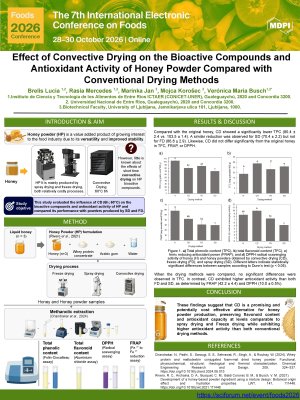
Honey powder (HP) is a value added product of growing interest to the food industry due to its versatility and improved stability. It is mainly produced by spray drying (SD) and freeze drying (FD), both relatively costly processes. However, little is known about the effects of short time convective drying (CD) on HP bioactive compounds. This study evaluated the influence of CD (6h; 60°C) on the bioactive compounds and antioxidant activity of HP and compared its performance with powders produced by SD and FD. The HP formulation was based on Rivero et al. (2021). Methanolic extracts from liquid honey (n = 3) and HP samples (n = 9; three per drying method) were prepared following Chandrakar et al. (2024) to determine total phenolic content (TPC; mg gallic acid/100 g), total flavonoid content (TFC; mg quercetin/100 g), 2,2-diphenyl-1-picrylhydrazyl radical scavenging activity (DPPH; % radical scavenging activity), and ferric reducing antioxidant power (FRAP; mg ascorbic acid/100 g). Compared with the original honey, CD showed a significantly lower TPC (80.4 ± 2.4 vs. 103.5 ± 1.4; Dunn's test, p < 0.05). A similar reduction was observed for SD (70.4 ± 2.2) but not for FD (86.8 ± 2.9), with no significant differences among drying methods. Likewise, CD did not differ significantly from the original honey in TFC, FRAP, or DPPH. When the drying methods were compared, no significant differences were observed in TFC. In contrast, CD exhibited higher antioxidant activity than both FD and SD, as determined by FRAP (42.2 ± 4.4) and DPPH (10.0 ± 0.5%). These findings suggest that CD is a promising and potentially cost effective alternative for honey powder production, preserving flavonoid content and antioxidant capacity at levels comparable to SD and FD while exhibiting higher antioxidant activity than both conventional drying methods.
Keywords
Honey powder
Convective drying
Bioactive compounds
Antioxidant activity
Phenolic compounds
Poster
BRELIS_CF2026_20261015_212408_0000.pdf
Effect of Wet Ageing on the Proximal Composition and Mineral Profile of Meat from Adult Serpentina Goats
Tropane Alkaloid Determination in Datura stramonium L. and Toxicological Assessment using Galleria mellonella Larvae