Event submissions
Published
This submission belongs to the session G. Food Safety, Toxicology & Quality of the event The 7th International Electronic Conference on Foods
Published date
23 Oct, 2026
Academic Editor
 Esther Sendra
Citation
Jolene Brito, Daniela Araújo, Renata Santana, Sílvia Cruz Barros, Joana Castro, Ricardo Oliveira, José Pinela, Tropane Alkaloid Determination in Datura stramonium L. and Toxicological Assessment using Galleria mellonella Larvae, in Proceedings of The 7th International Electronic Conference on Foods, 28 October–30 October 2026, MDPI: Basel, Switzerland
Share
Email
Facebook
Twitter
LinkedIn
Tropane Alkaloid Determination in Datura stramonium L. and Toxicological Assessment using Galleria mellonella Larvae

Jolene Brito 1

Daniela Araújo 1
Renata Santana 1
Sílvia Cruz Barros 1

Joana Castro 1,2

Ricardo Oliveira 1

José Pinela 1,3
1. National Institute for Agricultural and Veterinary Research (INIAV, I.P.), Rua dos Lágidos, Lugar da Madalena, 4485-655 Vairão – Vila do Conde, Portugal
2. Centre of Biological Engineering, University of Minho, 4710-057 Braga, Portugal
3. CIMO, LA SusTEC, Instituto Politécnico de Bragança, Campus de Santa Apolónia, 5300-253 Bragança, Portugal
Abstract
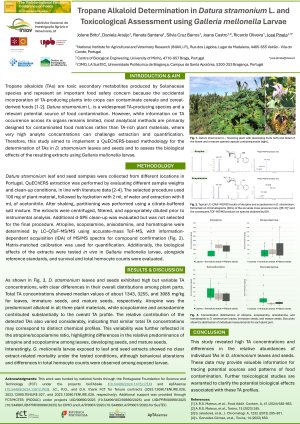
Tropane alkaloids (TAs) are toxic secondary metabolites produced by several Solanaceae species and represent an important food safety concern. Datura stramonium L. is a relevant TA-producing species frequently implicated in food contamination incidents. However, while information on TA occurrence across its organs and their toxicological significance remains limited, most analytical methods are primarily designed for contaminated food matrices rather than TA-rich plant materials. Therefore, this study aimed to optimize a methodology for TA determination in D. stramonium and to evaluate the toxicity of its extracts. Plant material was collected, homogenized, and subjected to extraction. QuEChERS-based methodologies reported in the literature were critically reviewed and adapted to develop an extraction protocol suitable for the high alkaloid content of D. stramonium. Different sample amounts (0.025–1.0 g) were tested while maintaining a constant solvent volume, and the influence of dispersive solid-phase extraction (dSPE) clean-up was investigated. TA profiles were determined by UHPLC-ToF-MS. Toxicological assessment was performed using Galleria mellonella larvae. The most suitable extraction conditions were achieved using 0.1 g of sample, whereas clean-up procedures did not significantly improve analytical performance. The predominant alkaloids detected in the seeds were atropine and scopolamine, with anisodamine and homatropine also being identified. Although no mortality was observed at the tested concentrations in the G. mellonella model, exposed larvae exhibited behavioral alterations and a statistically significant increase in hemocyte counts, suggesting sublethal effects under the tested conditions. These preliminary findings provide a methodological basis for TA determination in D. stramonium and may contribute to future risk assessment and source-tracing strategies for food contamination events involving TAs.
Keywords
food safety
plant toxins
UHPLC-ToF-MS
QuEChERS
in vivo toxicity
Poster
Poster Foods.pdf
Effect of Convective Drying on the Bioactive Compounds and Antioxidant Activity of Honey Powder Compared with Conventional Drying Methods
Effectiveness of Sanitizers Applied During Poultry Chilling for Reducing Campylobacter Contamination on Chicken Meat: A Meta-Analysis