Event submissions
Published
This submission belongs to the session G. Food Safety, Toxicology & Quality of the event The 7th International Electronic Conference on Foods
Published date
23 Oct, 2026
Academic Editor
 Esther Sendra
Citation
Odete Linda Armando Zefanias, Ana Novo Barros, Vasco Augusto Pilão Cadavez, Ursula Gonzales-Barron, Effectiveness of Sanitizers Applied During Poultry Chilling for Reducing Campylobacter Contamination on Chicken Meat: A Meta-Analysis, in Proceedings of The 7th International Electronic Conference on Foods, 28 October–30 October 2026, MDPI: Basel, Switzerland
Share
Email
Facebook
Twitter
LinkedIn
Effectiveness of Sanitizers Applied During Poultry Chilling for Reducing Campylobacter Contamination on Chicken Meat: A Meta-Analysis

Odete Linda Armando Zefanias 1,2

Ana Novo Barros 3

Vasco Augusto Pilão Cadavez 1

Ursula Gonzales-Barron 1
1. CIMO, LA SusTEC, Instituto Politécnico de Bragança, Campus de Santa Apolónia, 5300-253 Bragança, Portugal
2. Instituto de Investigação Agrária de Moçambique (IIAM) - Divisão de Ciências Animais, Av. de Moçambique, Km 1,5, Maputo 1922, Moçambique
3. Centre for the Research and Technology of Agro-Environmental and Biological Sciences (CITAB), University of Trás-os-Montes e Alto Douro (UTAD), Vila Real, 5000-801, Portugal
Abstract
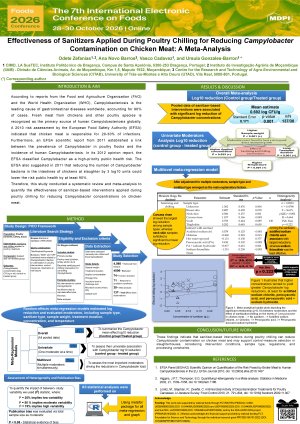
Campylobacter contamination in poultry meat remains a food safety challenge for the industry. This study conducted a systematic review and meta-analysis to quantify the effectiveness of sanitizer-based interventions applied during poultry chilling for reducing Campylobacter concentrations on chicken meat. A PRISMA-guided Scopus search identified 4,080 records, of which 30 studies met the eligibility criteria and provided 137 effect-size observations. Random-effects meta-regression models estimated log reductions and evaluated moderators, including sample type, sanitizer type, sample weight, treatment duration, concentration, treatment temperature, and storage time. Overall, sanitizer-based interventions during chilling significantly reduced Campylobacter levels, with a mean estimated reduction of 0.692 log (SE = 0.176; p < 0.001). In univariate analyses, applied concentration (p = 0.033), sample weight, contact time, and treatment temperature (all p < 0.001) were significantly associated with reductions. After adjustment for multiple moderators, sample type and sanitizer type emerged as the main explanatory factors. Carcass rinses showed the largest reduction among sample types, with a mean decrease of 1.017 log (SE = 0.166; p < 0.001). Neck skin samples showed a lower but significant reduction of 0.506 log (SE = 0.157; p < 0.001), whereas thigh skin samples showed a smaller, non-significant reduction of 0.292 log (SE = 0.645; p = 0.650). Sanitizer type also influenced Campylobacter reduction. Acidified sodium chlorite (0.578 log; SE = 0.125; p < 0.001) and peroxyacetic acid (0.410 log; SE = 0.102; p < 0.001) were associated with the largest reductions. Sodium thiosulfate showed a negative estimated effect (-1.351 log; SE = 0.258; p < 0.001), requiring cautious interpretation, particularly if used as a neutralising agent rather than an antimicrobial treatment. These findings indicate that sanitizer-based interventions during poultry chilling can reduce Campylobacter contamination on chicken meat and may support control-measure selection in slaughterhouses, considering intervention conditions, sample type, regulations, and processing constraints.
Keywords
Campylobacteriosis
chicken meat
chilling
sanitizers-based
meta-regression
Poster
POSTER_FOODS2026152612.pdf
Tropane Alkaloid Determination in Datura stramonium L. and Toxicological Assessment using Galleria mellonella Larvae
Ursolic And Oleanolic Acid-Rich Extract From Rosmarinus Officinalis L.: in vitro and in vivo biological potential