Event submissions
Published
This submission belongs to the session B. Nutritional & Functional Foods of the event The 7th International Electronic Conference on Foods
Published date
23 Oct, 2026
Academic Editor
 Manuel Viuda-Martos
Citation
Lorenza Marinaccio, Giulia Gentile, Marzia Smigliani, Angelo Cichelli, Gokhan Zengin, Stefano Pieretti, Simone De Fabritiis, Fabio Verginelli, Azzurra Stefanucci, Adriano Mollica, Ursolic And Oleanolic Acid-Rich Extract From Rosmarinus Officinalis L.: in vitro and in vivo biological potential, in Proceedings of The 7th International Electronic Conference on Foods, 28 October–30 October 2026, MDPI: Basel, Switzerland
Share
Email
Facebook
Twitter
LinkedIn
Ursolic And Oleanolic Acid-Rich Extract From Rosmarinus Officinalis L.: in vitro and in vivo biological potential

Lorenza Marinaccio 1
Giulia Gentile 2
Marzia Smigliani 2
Angelo Cichelli 1

Gokhan Zengin 3
Stefano Pieretti 4
Simone De Fabritiis 5

Fabio Verginelli 5,6

Azzurra Stefanucci 2,7

Adriano Mollica 2,7
1. Department of Innovative Technologies in Medicine and Dentistry, "G. d'Annunzio" University of Chieti-Pescara, 66100 Chieti, Italy.
2. Department of Pharmacy, "G. d'Annunzio" University of Chieti-Pescara, 66100 Chieti, Italy.
3. Department of Biology, Selcuk University, 42130 Konya, Turkey.
4. National Centre for Drug Research and Evaluation, Istituto Superiore di Sanità, Rome 00161, Italy.
5. Center for Advanced Studies and Technology (CAST), "G. d'Annunzio" University of Chieti-Pescara, 66100 Chieti, Italy.
6. Department of Sciences, "G. d'Annunzio" University of Chieti-Pescara, 66100 Chieti, Italy.
7. SCM Nutraceutici Universitari Srl, Strada degli Oliveti 73, 66100 Chieti, Italy.
Abstract
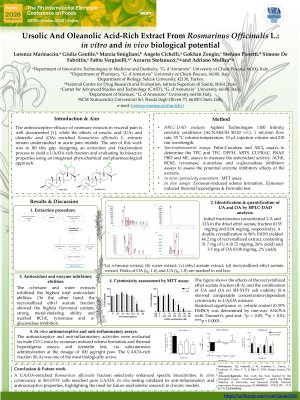
Rosmarinus officinalis L. is an aromatic plant containing ursolic (UA) and oleanolic (OA) acids, known for their anti-inflammatory activity. In this work different extracts were evaluated for their in vitro and in vivo biological potential.
The n-hexane (R-H), ethyl acetate (R-A) and water (R-W) extracts were prepared from Rosmarinus officinalis L. The R-A extract underwent to a double crystallization obtaining white solid crystals enriched with UA/OA. UA and OA were quantified by HPLC-DAD. The total phenolic (TPC) and flavonoid (TFC) contents were determined through spectrophotometric assays. DPPH, ABTS, FRAP, CUPRAC, MCA and PBD antioxidant assays were also performed. Enzyme inhibition was determined against AChE, BChE, tyrosinase, α-amylase, and α-glucosidase. SH-SY5Y cell viability was determined by MTT after the treatment with the R-A extract and UA/OA combination. Zymosan-induced edema formation, Zymosan-induced thermal hyperalgesia and Formalin test were applied to determine the anti-inflammatory and analgesic effects in vivo.
R-H showed the highest TPC, while R-A exhibited the highest TFC. The R-H extract showed the highest radical scavenging activity, while the R-W demonstrated the strongest reducing power effect. In MTT assay, R-A induced a time and concentration dependent reduction in SH-SY5Y cell viability, similarly to UA/OA combination. This indicates that UA and OA are primary contributors to the triterpene-rich fraction’s activity. The R-A extract showed lower cytotoxicity, suggesting that other constituents may partially reduce UA/OA-induced toxicity. Finally, in vivo R-A and R-W extracts showed a significant inhibition of edema formation. The hyperalgesia induced by Zymosan was reversed in this order: R-W>R-A>R-H. R-A and R-W extracts significantly decreased the nociceptive response in the late phase of the Formalin test.
The R-A extract showed the highest TFC and analgesic and anti-inflammatory effects in vivo, suggesting its potential as a natural anti-inflammatory agent.
Keywords
Rosmarinus officinalis
antioxidant
cytotoxicity
anti-inflammatory activity
Poster
Poster_Foods2026_LM.pdf
Effectiveness of Sanitizers Applied During Poultry Chilling for Reducing Campylobacter Contamination on Chicken Meat: A Meta-Analysis
Beyond Gluten Removal: Nutritional Perceptions and Deficiency Awareness in Gluten-Free Diet Followers