Event submissions
Published
This submission belongs to the session G. Food Safety, Toxicology & Quality of the event The 7th International Electronic Conference on Foods
Published date
23 Oct, 2026
Academic Editor
 Esther Sendra
Citation
Mina Janković, Ivana Beara, Ljilja Torović, Beyond Gluten Removal: Nutritional Perceptions and Deficiency Awareness in Gluten-Free Diet Followers, in Proceedings of The 7th International Electronic Conference on Foods, 28 October–30 October 2026, MDPI: Basel, Switzerland
Share
Email
Facebook
Twitter
LinkedIn
Beyond Gluten Removal: Nutritional Perceptions and Deficiency Awareness in Gluten-Free Diet Followers

Mina Janković 1
Ivana Beara 2

Ljilja Torović 3
1. Department of General Education Subjects, Faculty of Medicine, University of Novi Sad, Novi Sad 21000, Serbia
2. Department of Chemistry, Biochemistry and Environmental Protection, Faculty of Sciences, University of Novi Sad, Novi Sad 21000, Serbia
3. Department of Pharmacy, Faculty of Medicine, University of Novi Sad, Novi Sad 21000, Serbia
Abstract
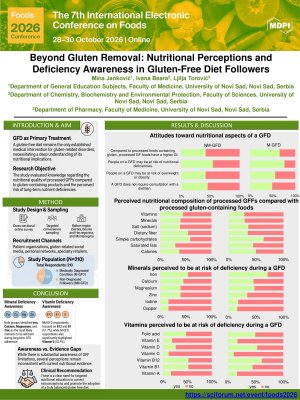
As a gluten-free diet (GFD) remains the only established treatment for gluten-related disorders, understanding its nutritional implications is essential for appropriate dietary counseling. This study evaluated the knowledge and perceptions of adults following a GFD regarding the nutritional quality of processed gluten-free foods (GFFs) compared with gluten-containing products, and the risk of nutrient deficiencies associated with long-term adherence.
A cross-sectional online survey used targeted convenience sampling among adults following a GFD in Serbia, Bosnia and Herzegovina, and Montenegro via patient organizations, gluten-related social media, personal networks, and gluten-free product retailers.
Among 210 respondents, 121 reported following a GFD due to a medically diagnosed condition (M-GFD group). In individuals without a diagnosed medical condition (NM-GFD), processed GFFs were most commonly perceived as higher in simple carbohydrates (58.4%) and dietary fiber (53.9%) but lower in calories (62.9%), saturated fats (70.8%), sodium (61.8%), minerals (60.7%), and vitamins (56.2%) than gluten-containing products. Similar but more pronounced perceptions were observed in the M-GFD group, with GFFs regarded as higher in simple carbohydrates (63.6%) and lower in vitamins (71.9%), minerals (71.1%), dietary fiber (65.3%), sodium (64.5%), saturated fats (55.4%), and calories (50.4%). Both groups most frequently identified iron, calcium, magnesium, and zinc as potentially deficient nutrients. Regarding vitamins, NM-GFD respondents most commonly reported vitamins B12 and B1 (51.7% each) and folic acid (47.2%), whereas M-GFD respondents additionally highlighted vitamin D (52.9%).
These findings demonstrate substantial awareness of the nutritional limitations of GFFs and long-term GFD adherence. However, several perceptions were inconsistent with current evidence, highlighting the need for targeted nutritional education to correct misconceptions and promote nutritionally balanced GFDs.
Funding: AP Vojvodina Provincial Secretariat for Higher Education and Scientific Research, Grant No. 003862016 2025 09418 003 000 000 001 04 004
Keywords
gluten-free diet
nutrient deficiency
questionnaire
public health
Poster
Foods 2026_GFD nutritional characteristics_Mina Jankovic.pdf
Ursolic And Oleanolic Acid-Rich Extract From Rosmarinus Officinalis L.: in vitro and in vivo biological potential
Genotoxicity and cytotoxicity screening of ethanol and water extracts of Lonicera caerulea leaf