Event submissions
Published
This submission belongs to the session G. Food Safety, Toxicology & Quality of the event The 7th International Electronic Conference on Foods
Published date
23 Oct, 2026
Academic Editor
 Esther Sendra
Citation
Shakirah Omotoke Azeez, Marcia English, Chibuike Udenigwe, Lord Abbey, Chijioke Emenike, Genotoxicity and cytotoxicity screening of ethanol and water extracts of Lonicera caerulea leaf, in Proceedings of The 7th International Electronic Conference on Foods, 28 October–30 October 2026, MDPI: Basel, Switzerland
Share
Email
Facebook
Twitter
LinkedIn
Genotoxicity and cytotoxicity screening of ethanol and water extracts of Lonicera caerulea leaf

Shakirah Omotoke Azeez 1
Marcia English 2

Chibuike Udenigwe 3,4
Lord Abbey 1

Chijioke Emenike 1
1. Department of Plant, Food, and Environmental Sciences, Faculty of Agriculture, Dalhousie University, Truro, NS B2N5E3, Canada
2. Department of Human Nutrition, Saint Francis Xavier University, Antigonish, NS B2G 2W5, Canada
3. School of Nutrition Sciences, University of Ottawa, Ottawa, Ontario, Canada
4. School of Agriculture, Food and Ecosystem Sciences, University of Melbourne, Melbourne, Victoria, Australia
Abstract
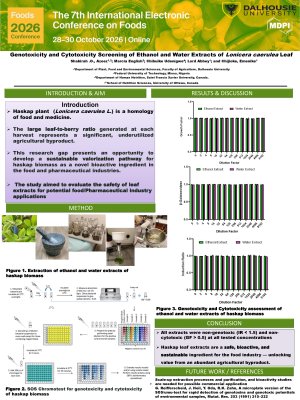
Lonicera caerulea L. (haskap) leaves represent an abundant agricultural by-product rich in bioactive phenolic compounds and secondary metabolites, yet their safety for food industry applications remains largely unknown. In this study, we evaluated the genotoxicity and cytotoxicity of ethanol and aqueous extracts of haskap leaves using the UMU-ChromoTest™, a bacterial SOS chromotest. A serial two-fold dilutions ranging from undiluted to 1:8192 were prepared for both extract types, and the assay was performed according to the EBPI UMU-ChromoTest™ procedure. Bacterial growth factor (GF) and β-galactosidase (β-Gal) induction ratio (IR) were calculated from absorbance readings at 600 nm and 420 nm, respectively. Results showed that for the ethanol extract, GF values ranged from 0.983 to 1.017 (mean 1.005 ± 0.011) and IR values from 0.983 to 1.017 (mean 1.006 ± 0.012). For the water extract, GF values ranged from 0.983 to 1.017 (mean 1.007 ± 0.011) and IR values from 0.977 to 1.023 (mean 0.993 ± 0.013). All values remained well within the established safety thresholds (GF > 0.5; IR < 1.5) across the entire dilution series. Neither extract exhibited a dose-dependent genotoxic or cytotoxic response. These findings demonstrate that both ethanol and water extracts of L. caerulea leaves are non-genotoxic and non-cytotoxic under the tested conditions, thereby supporting their potential as safe bioactive ingredients in food and pharmaceutical industries and offering a sustainable route to valorize an abundant agricultural byproduct.
Keywords
Lonicera caerulea L.
By-product
Genotoxicity
Cytotoxicity
Safety
Poster
Poster-Shakirah Azeez.pdf
Beyond Gluten Removal: Nutritional Perceptions and Deficiency Awareness in Gluten-Free Diet Followers
Valorization of Pumpkin Flesh and Peel Flours as Sustainable Ingredients for Semolina Pasta: Effects on Color and Cooking Quality