Event submissions
Published
This submission belongs to the session B. Nutritional & Functional Foods of the event The 7th International Electronic Conference on Foods
Published date
23 Oct, 2026
Academic Editor
 Manuel Viuda-Martos
Citation
Fatbardha Terstena, Agata Wojciechowicz, Ewa Pejcz, Durim Alija, Gafur Xhabiri, Joanna Harasym, Valorization of Pumpkin Flesh and Peel Flours as Sustainable Ingredients for Semolina Pasta: Effects on Color and Cooking Quality, in Proceedings of The 7th International Electronic Conference on Foods, 28 October–30 October 2026, MDPI: Basel, Switzerland
Share
Email
Facebook
Twitter
LinkedIn
Valorization of Pumpkin Flesh and Peel Flours as Sustainable Ingredients for Semolina Pasta: Effects on Color and Cooking Quality

Fatbardha Terstena 1
Agata Wojciechowicz 2
Ewa Pejcz 2
Durim Alija 1
Gafur Xhabiri 1

Joanna Harasym 2,3
1. Faculty of Food Technology and Nutrition, University of Tetova, Str. Ilinden, nn., 1200 Tetova, North Macedonia
2. Department of Biotechnology and Food Analysis, Wroclaw University of Economics and Business, Komandorska 118/120, 53-345 Wroclaw, Poland
3. Adaptive Food Systems Accelerator-Science Centre, Wroclaw University of Economics and Business, 53-345 Wroclaw, Poland
Abstract
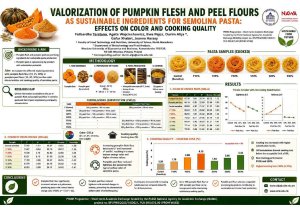
The incorporation of plant-derived ingredients and food processing by-products into cereal products is a promising strategy for improving the sustainability of food production. Pumpkin peel, a vegetable processing by-product, and pumpkin flesh have potential as alternative ingredients for pasta manufacture. This study evaluated the effects of partially replacing durum wheat semolina with pumpkin flesh flour (10, 25, and 50%) or pumpkin peel flour (10, 20, and 30%) on the color of dough and cooked pasta, as well as on cooking quality. Pasta samples were prepared by substituting semolina with the respective pumpkin flours at different levels. Color parameters (L*, a*, b*, chroma, and hue angle) were measured using the CIELab color system, while cooking quality was evaluated by determining cooking loss. The significance level was set at p < 0.05. Pumpkin flour incorporation significantly (p < 0.05) affected the color of both dough and cooked pasta. Increasing the proportion of pumpkin flesh flour decreased lightness (L*) and increased redness (a*) and yellowness (b*), resulting in a more intense orange color with higher chroma values. Cooked pasta containing 50% pumpkin flesh flour exhibited the highest color intensity (a* ≈ 7; b* > 32). Pumpkin peel flour also reduced lightness but produced smaller changes in redness, preserving the characteristic yellow color of semolina pasta. Cooking loss increased with increasing substitution level but remained below the acceptable quality limit of 8% for all formulations. The control sample showed the lowest cooking loss (1.29%), whereas pasta containing 50% pumpkin flesh flour exhibited the highest value (4.19%). Formulations containing up to 10% pumpkin flesh flour or 30% pumpkin peel flour maintained satisfactory cooking performance. These findings indicate that pumpkin flesh and pumpkin peel flour can be incorporated into semolina pasta to modify product color while maintaining acceptable cooking quality under the conditions evaluated. The use of pumpkin peel also represents a potential approach for the valorization of vegetable processing by-products.
Keywords
semolina pasta
pumpkin peel flour
pumpkin flesh flour
cooked pasta
color
cooking loss
food by-products
circular economy.
Poster
Sciforum-202198 Fatbardha Terstena.pdf
Genotoxicity and cytotoxicity screening of ethanol and water extracts of Lonicera caerulea leaf
Impact of Bean-Flour Sourdough on Technological Quality, Colour and Antioxidant Properties of Wheat-Based Bread