Event submissions
Published
This submission belongs to the session B. Nutritional & Functional Foods of the event The 7th International Electronic Conference on Foods
Published date
23 Oct, 2026
Academic Editor
 Manuel Viuda-Martos
Citation
Besar Jumniu, Ewa Pejcz, Agata Wojciechowicz, Durim Alija, Gafur Xhabiri, Joanna Harasym, Impact of Bean-Flour Sourdough on Technological Quality, Colour and Antioxidant Properties of Wheat-Based Bread, in Proceedings of The 7th International Electronic Conference on Foods, 28 October–30 October 2026, MDPI: Basel, Switzerland
Share
Email
Facebook
Twitter
LinkedIn
Impact of Bean-Flour Sourdough on Technological Quality, Colour and Antioxidant Properties of Wheat-Based Bread

Besar Jumniu 1
Ewa Pejcz 2
Agata Wojciechowicz 2
Durim Alija 1
Gafur Xhabiri 1

Joanna Harasym 3
1. Faculty of Food Technology and Nutrition, University of Tetova, Str. Ilinden, nn 1200 Tetova, North Macedonia
2. Department of Biotechnology and Food Analysis, Wroclaw University of Economics and Business, Komandorska 118/120, 53-345 Wroclaw, Poland
3. Department of Biotechnology and Food Analysis, Wroclaw University of Economics and Business, 53-345 Wrocław, Poland
Abstract
Introduction: Sourdough fermentation is a useful biotechnological approach for improving the technological and functional potential of bakery products enriched with legume ingredients. Bean flour may provide additional functionality, but its influence on bread quality depends on fermentation behaviour and formulation. This study investigated the effect of bean-flour sourdough and wheat-bean flour formulations on wheat-based bread properties.
Methods: Bean flour sourdoughs were incorporated into wheat-based formulations. Doughs were fermented at 35 °C for 2 h and baked at 220 °C for 15 min. Breads were assessed for pH, baking loss, water activity, colour, aroma profile, total phenolics, reducing sugars and antioxidant properties.
Results and Discussion: The soaked-bean sourdough showed stronger acidification than the boiled-bean sourdough, with pH values of 4.59 and 5.28, respectively. Baking loss ranged from 12.36% in the control bread to 18.80% in bread prepared with the wheat–boiled bean flour blend and boiled-bean sourdough, while water activity remained high and stable (0.977-0.984). Bean-flour formulation and sourdough addition affected bread colour, especially crust lightness, which decreased to 35.51 and 34.48 in breads with wheat-boiled bean and wheat-soaked bean flour blends, respectively, compared with 50.53 in the control. Electronic-nose analysis showed that bean-flour formulation influenced the volatile profile of the breads, with the clearest differences related to sensor responses associated with nitrogen-containing compounds and sulfur- and terpene-related volatiles. Antioxidant properties were modified; in the crumb of bread prepared with the wheat-boiled bean flour blend and boiled-bean sourdough, total phenolic content reached 0.922 mg GAE/g DM in water extract and 1.387 mg GAE/g DM in ethanol extract.
Conclusions: Bean-flour sourdoughs and wheat–bean flour formulations influenced baking performance, colour, aroma profile and antioxidant properties, supporting their potential for functional wheat-based bread.
Keywords
bean-flour sourdough
wheat-based bread
technological quality
colour
antioxidant properties
volatile profile
Poster
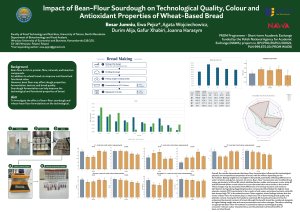
Impact of Bean-Flour Sourdough on Technological Quality, Control and Antioxidant Properties of Wheat-Based Bread.pdf
Valorization of Pumpkin Flesh and Peel Flours as Sustainable Ingredients for Semolina Pasta: Effects on Color and Cooking Quality
Enriching croissants with orange peel by-product powder: Impact on FTIR fingerprint and bioactive quality