Event submissions
Published
This submission belongs to the session B. Nutritional & Functional Foods of the event The 7th International Electronic Conference on Foods
Published date
23 Oct, 2026
Academic Editor
 Manuel Viuda-Martos
Citation
Ana Rita Miguel, António Lopes João, Maria Manuela Guerra, Healthy Indulgence: New Formulation and Validation of a Dessert for Dietary Restrictions, in Proceedings of The 7th International Electronic Conference on Foods, 28 October–30 October 2026, MDPI: Basel, Switzerland
Share
Email
Facebook
Twitter
LinkedIn
Healthy Indulgence: New Formulation and Validation of a Dessert for Dietary Restrictions

Ana Rita Miguel 1
António Lopes João 1
Maria Manuela Guerra 1,2
1. Department of Health, Food Science and Technology. Estoril Higher Institute for Tourism and Hotel Studies (ESHTE). Estoril. Av. Condes de Barcelona, n. 808. 2769-510. Estoril, Portugal.
2. Center for Research, Development and Innovation in Tourism (CiTUR). Estoril Higher Institute for Tourism and Hotel Studies (ESHTE). Estoril. Av. Condes de Barcelona, n. 808. 2769-510. Estoril, Portugal
Abstract
Introduction
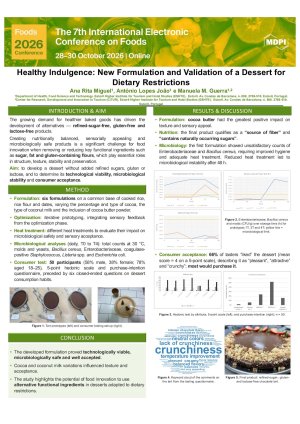
The growing demand for healthier baked goods has driven the development of alternatives — refined sugar free, gluten free, and lactose free products. Creating nutritionally balanced, sensorially appealing, and microbiologically safe products is a significant challenge for food innovation when removing or reducing key functional ingredients such as sugar, fat, and gluten containing flours, which play essential roles in structure, texture, stability, and preservation. Objectives This study aimed to develop a dessert product without added refined sugars, gluten, or lactose, and to determine its technological viability, microbiological stability, and consumer acceptance.
Methodology
Six formulations were developed using a common base, incorporating cooked rice, rice flour, and dates, and varying the percentage and type of cocoa, type of coconut milk, and inclusion of cocoa butter powder. The recipe was optimized through iterative prototyping, integrating sensory feedback from the optimization phase. The formulations were subjected to different heat treatments to evaluate their impact on microbiological safety and sensory acceptance. Microbiological analyses included total counts at 30°C, molds and yeasts, Bacillus cereus, Enterobacteriaceae, coagulase positive Staphylococcus, Listeria spp., and Escherichia coli, performed daily from T0 to T4. The final product was evaluated by 50 participants (58% male, 38% female; 78% aged 18–25) using a 9 point hedonic scale and a purchase intention questionnaire preceded by six closed ended questions on dessert consumption habits.
Results
Cocoa butter had the greatest positive impact on texture and sensory appeal. The first formulation showed unsatisfactory counts of Enterobacteriaceae and Bacillus cereus, requiring improved hygiene and adequate heat treatment. Reduced heat treatment led to microbiological instability after 48 hours. The final product qualifies as a “source of fiber” and “contains naturally occurring sugars”. In consumer testing, 66% of tasters “liked” the dessert (mean score = 4), describing it as “pleasant”, “attractive”, and “crunchy”, and most indicated they would purchase it.
Conclusions
The developed formulation proved technologically viable, microbiologically safe, and well accepted. Cocoa and coconut milk variations influenced texture and acceptance. The study highlights the potential of food innovation to use alternative functional ingredients in desserts adapted to dietary restrictions.
Keywords
New product development
pastry
shelf life
food safety
consumer acceptance
Poster
Poster_Foods2026_Healthy_Indulgence.pdf
Enriching croissants with orange peel by-product powder: Impact on FTIR fingerprint and bioactive quality
Contribution of bioactive compounds from walnut and almond by-products to the modulation of oxidative stress and cell survival in Caco-2 cells.