Event submissions
Published
This submission belongs to the session B. Nutritional & Functional Foods of the event The 7th International Electronic Conference on Foods
Published date
23 Oct, 2026
Academic Editor
 Manuel Viuda-Martos
Citation
Maria Eugenia Sabatino, Mariana Soledad Lingua, Ayelén Diaz Reynoso, Marcela Martinez, Maria Verónica Baroni, Contribution of bioactive compounds from walnut and almond by-products to the modulation of oxidative stress and cell survival in Caco-2 cells., in Proceedings of The 7th International Electronic Conference on Foods, 28 October–30 October 2026, MDPI: Basel, Switzerland
Share
Email
Facebook
Twitter
LinkedIn
Contribution of bioactive compounds from walnut and almond by-products to the modulation of oxidative stress and cell survival in Caco-2 cells.

Maria Eugenia Sabatino 1
Mariana Soledad Lingua 2
Ayelén Diaz Reynoso 3
Marcela Martinez 4
Maria Verónica Baroni 5
1. National University of Córdoba, National Council for Scientific and Technical Research (CONICET), Institute for Health Sciences Research (INICSA), Córdoba, X5000, Argentina.
2. National Institute of Agricultural Technology, National Council for Scientific and Technical Research (CONICET), Dairy Chain Research Institute (IdICaL), Rafaela, S2300, Argentina
3. Faculty of Chemical Sciences, National University of Córdoba, Center for Applied Chemistry (CEQUIMAP), Córdoba, X5000, Argentina.
4. National University of Córdoba, National Council for Scientific and Technical Research (CONICET), Multidisciplinary Institute of Plant Biology (IMBIV), Córdoba, X5000, Argentina
5. National University of Córdoba, National Council for Scientific and Technical Research (CONICET), Institute of Food Science and Technology Córdoba (ICYTAC), Córdoba, X5000, Argentina
Abstract
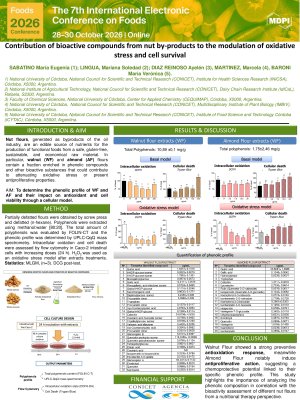
Nut flours, byproducts of the oil industry, are an edible source for functional foods from a safe, gluten-free, sustainable, and raw material. In particular, walnut (WF) and almond (AF) flours are enriched in polyphenols and other bioactive substances that could present antioxidant and antiproliferative properties. In the present study, WF and AF phenolic profile were determined and their impact on antioxidant and cell viability has been examined through a cellular model.
Partially defatted flours by screw press were defatted, and polyphenols were extracted [MetOH 80 :H2O 20]. The total amount of polyphenols (PT) was evaluated by FOLIN-CT and the phenolic profile by UPLC-QqQ mass spectrometry. Intracellular oxidation (DCFH-DA) and cell death (Trypan Blue) were assessed as mean intensity by flow cytometry in Caco-2 cells with increasing PT doses for 24 h (WF: 17-250 µg/mL of PT; AF: 1.7-25.0 µg/mL of PT). H2O2 (1.5 mM, 1 h) was used as an oxidative stress model after treatments. Statistics: MLGM, (n=3). DCG post-test.
The WF major compounds found were: Quercetin pentoside isomer> Glansreginin A> Catechin>Gallic acid. Regarding AF, the major compounds were: Quinic acid> Hesperidin> Isorh-3-O-rutinoside> Epicatechin. WF exhibited a reduction in oxidation (50%), while did not compromise cell viability except at 250 µg/mL. The AF showed a 20% a decrease in oxidation and a dose-dependent increase in cell death (90%). Also, WF showed a notable attenuation of H₂O₂-induced oxidation (200%) and cell death (100%). The AF provoked a dose-dependent reduction of oxidation (200%). AF doses increased the toxicity of the oxidative model.
In conclusion, WF showed a strong preventive antioxidation response, meanwhile AF notably induce antiproliferative action, suggesting a chemoprotective potential linked to their specific phenolic profile. This study highlights the importance of analyzing the phenolic composition in correlation with the bioactivity assessment of different nut flours from a nutritional therapy perspective.
Keywords
NUT FLOURS
CELL CULTURE
PHENOLIC PROFILE
ANTIOXIDANT
ANTIPROLIFERATIVE.
Poster
Poster_SciForum_2026_Sabatino.pdf
Healthy Indulgence: New Formulation and Validation of a Dessert for Dietary Restrictions
The Role of UC-Associated Microbiota in Fiber Fermentation and Tolerance