Event submissions
Published
This submission belongs to the session B. Nutritional & Functional Foods of the event The 7th International Electronic Conference on Foods
Published date
23 Oct, 2026
Academic Editor
 Manuel Viuda-Martos
Citation
Elena Preite, Monica Rosa Loizzo, Marco Bonesi, Maria Pia Scutifero, Rosa Tundis, Exploring Poncirus trifoliata Fruits as a Source of Natural Antioxidants: Influence of Ripening Stage, in Proceedings of The 7th International Electronic Conference on Foods, 28 October–30 October 2026, MDPI: Basel, Switzerland
Share
Email
Facebook
Twitter
LinkedIn
Exploring Poncirus trifoliata Fruits as a Source of Natural Antioxidants: Influence of Ripening Stage

Elena Preite 1

Monica Rosa Loizzo 1
Marco Bonesi 1
Maria Pia Scutifero 1

Rosa Tundis 1
1. Department of Pharmacy, Health and Nutritional Sciences - University of Calabria, 87036 Cosenza, Italy
Abstract
Introduction
Poncirus trifoliata (L.) Raf. (Rutaceae), known as trifoliate orange, is a deciduous species characterized by small yellow-orange fruits, closely related to Citrus species. The fruits are traditionally employed in the preparation of jams, beverages and as herbal remedies in some Asian countries. Recently, P. trifoliata has attracted scientific interest because of its phytochemical profile including phenolic acids, flavonoids, coumarins, limonoids and essential oils. These phytochemicals have been associated with several biological activities, such as antioxidant, anti-inflammatory, antimicrobial and anticancer effects. The novelty of this study is the comparative investigation of immature and mature P. trifoliata fruits, providing new insights into the influence of fruit maturity on phytochemical composition and bioactive properties while supporting their sustainable reuse as agro-industrial by-products.
Methods
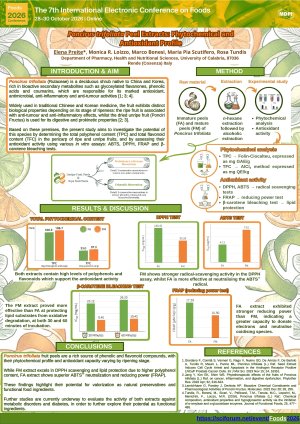
The peel of immature and mature fruits of P. trifoliata has been exhaustively extracted by maceration using ethanol as solvent. The antioxidant activity was assessed by applying different in vitro tests including DPPH, ABTS, FRAP and b-carotene bleaching assays and results were analysed in relation to the total phenol content (TPC) and total flavonoid content (TFC).
Results and Discussion
The total phenolic and flavonoid contents were found to be slightly higher in mature fruits (106.7 mg chlorogenic acid equivalents/g and 37.3 mg quercetin equivalents/g, respectively) compared to immature fruits (100.3 mg/g and 33.0 mg/g). The results showed that both immature peel (FA) and mature peel (FM) extracts of P. trifoliata possess significant antioxidant potential. The FM extract exhibited stronger activity in the DPPH and b-carotene bleaching tests. Conversely, the FA extract showed higher efficacy in the ABTS test and a greater FRAP value (17.20 μM Fe(II)/g) compared to the FM extract (10.90 μM Fe(II)/g).
Conclusions
These preliminary findings highlight the potential of P. trifoliata fruit by-product as a valuable source of natural antioxidants.
Keywords
Trifoliate orange
functional food
by-products
polyphenols
antioxidant activity
Poster
Poster 7th Electronic Conference on Foods - Elena Preite.pdf
The Role of UC-Associated Microbiota in Fiber Fermentation and Tolerance
Upcycling Grape Pomace into Functional Bread: A Sustainable Valorization Strategy