Event submissions
Published
This submission belongs to the session B. Nutritional & Functional Foods of the event The 7th International Electronic Conference on Foods
Published date
23 Oct, 2026
Academic Editor
 Manuel Viuda-Martos
Citation
Roberta Pino, Vincenzo Sicari, antonio gattuso, Rosa Tundis, antonio mincione, Monica Rosa Loizzo, Upcycling Grape Pomace into Functional Bread: A Sustainable Valorization Strategy, in Proceedings of The 7th International Electronic Conference on Foods, 28 October–30 October 2026, MDPI: Basel, Switzerland
Share
Email
Facebook
Twitter
LinkedIn
Upcycling Grape Pomace into Functional Bread: A Sustainable Valorization Strategy

Roberta Pino 1

Vincenzo Sicari 2
antonio gattuso 2

Rosa Tundis 1
antonio mincione 2

Monica Rosa Loizzo 1
1. Department of Pharmacy, Health and Nutritional Sciences, University of Calabria, 87036 Arcavacata di Rende (CS), Italy
2. Department of Agraria, University “Mediterranea” of Reggio Calabria, Salita Melissari, Feo di Vito, 89124 Reggio Calabria, Italy.
Abstract
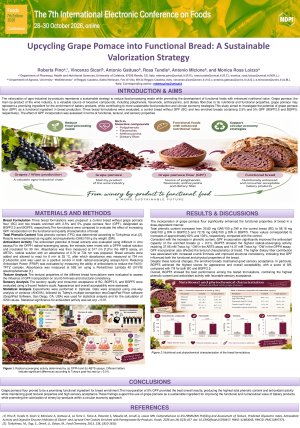
The valorization of agro-industrial by-products has gained increasing attention as a sustainable strategy for developing functional foods with enhanced nutritional value. Among these by-products, grape pomace, the main residue of the wine industry, is rich in bioactive compounds such as polyphenols, flavonoids, anthocyanins, and dietary fiber, making it a promising ingredient for food enrichment. This study investigated the effects of grape pomace flour (GPF) incorporation on the functional, textural, and sensory characteristics of bread. Three formulations were prepared: a control bread without GPF (BC) and two enriched breads containing 2.5% and 5% GPF (BGPF2.5 and BGPF5). The addition of GPF resulted in a significant dose-dependent increase in bioactive compounds. Total phenolic content increased from 35.82 mg gallic acid equivalents (GAE)/100 g dry weight (DW) in the control bread to 58.18 and 72.78 mg GAE/100 g DW in breads containing 2.5% and 5% GPF, corresponding to increases of approximately 62% and 103%. The functional properties of the breads were evaluated through ABTS and DPPH radical scavenging assays. Antioxidant activity was significantly enhanced by GPF incorporation (p < 0.01), with the highest values observed in the 5% GPF formulation, reaching 37.56 mM Trolox kg⁻¹ DW (ABTS) and 14.37 mM Trolox kg⁻¹ DW (DPPH). These findings confirm the contribution of GPF to improving the antioxidant potential of bread. Texture analysis showed that the higher dietary fiber content of GPF increased crumb firmness and improved structural consistency. Sensory quality was assessed using a 9-point hedonic scale, and the enriched breads showed good consumer acceptance. The bread containing 5% GPF obtained the highest scores for appearance and overall acceptability (8/9), outperforming both the control and the 2.5% GPF bread (7/9). Overall, the results demonstrate that GPF is a sustainable ingredient capable of enhancing the nutraceutical value and consumer appeal of bakery products while supporting circular economy strategies through the valorization of winery by-products.
Keywords
grape pomace flour
functional bread
polyphenols
antioxidant activity
sensory analysis
texture profile analysis
circular economy
food by-products.
Poster
Poster Roberta Pino foods_2026.pdf
Exploring Poncirus trifoliata Fruits as a Source of Natural Antioxidants: Influence of Ripening Stage
Ethanolic and Methanolic Extraction of Phenolic Compounds and Their Antioxidant Capacity by DPPH and FRAP from Cahuiche Fruit (Vaccinium leucanthum)