Event submissions
Published
This submission belongs to the session B. Nutritional & Functional Foods of the event The 7th International Electronic Conference on Foods
Published date
23 Oct, 2026
Academic Editor
 Manuel Viuda-Martos
Citation
Agata Wojciechowicz, Ewa Pejcz, Patryk Słota, Aniceta Ślęczka, Joanna Harasym, Effect of Milk Thistle (Silybum marianum L.) Addition on the Quality and Nutritional Value of Rye Bread, in Proceedings of The 7th International Electronic Conference on Foods, 28 October–30 October 2026, MDPI: Basel, Switzerland
Share
Email
Facebook
Twitter
LinkedIn
Effect of Milk Thistle (Silybum marianum L.) Addition on the Quality and Nutritional Value of Rye Bread

Agata Wojciechowicz 1
Ewa Pejcz 1
Patryk Słota 1
Aniceta Ślęczka 2

Joanna Harasym 1
1. Department of Biotechnology and Food Analysis, Wroclaw University of Economics and Business, Wrocław, 53-345, Komandorska 118 Street, Poland
2. Department of Food Technology and Nutrition, Wroclaw University of Economics and Business, Wrocław, 53-345, Komandorska 118 Street, Poland
Abstract
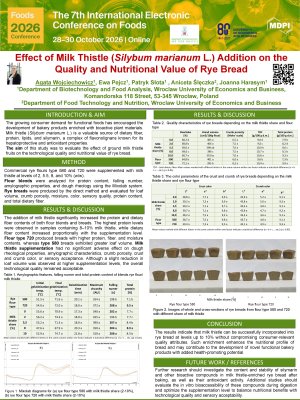
The growing consumer demand for functional foods has encouraged the development of bakery products enriched with bioactive plant materials. Milk thistle (Silybum marianum L.) is a valuable source of dietary fiber, protein, lipids, and silymarin, a complex of flavonolignans known for its hepatoprotective and antioxidant properties. The aim of this study was to evaluate the effect of ground milk thistle fruits on the technological quality and nutritional value of rye bread.
Commercial rye flours type 580 and 720 were supplemented with milk thistle at levels of 2, 5.5, 8, and 10% (w/w). Flour blends were analyzed for protein content, falling number, amylographic properties, and dough rheology using the Mixolab system. Rye breads were produced by the direct method and evaluated for loaf volume, crumb porosity, moisture, color, sensory quality, protein content, and total dietary fiber.
The addition of milk thistle significantly increased the protein and dietary fiber contents of both flour blends and breads. The highest protein levels were observed in samples containing 8–10% milk thistle, while dietary fiber content increased proportionally with the supplementation level. Flour type 720 produced breads with higher protein, fiber, and moisture contents, whereas type 580 breads exhibited greater loaf volume. Milk thistle supplementation had no significant adverse effect on dough rheological properties, amylographic characteristics, crumb porosity, crust and crumb color, or sensory acceptance. Although a slight reduction in loaf volume was observed at higher supplementation levels, the overall technological quality remained acceptable.
The results indicate that milk thistle can be successfully incorporated into rye bread at levels up to 10% without compromising consumer-relevant quality attributes. Such enrichment enhances the nutritional profile of bread and may contribute to the development of novel functional bakery products with added health-promoting potential.
Keywords
rye bread
milk thistle
Silybum marianum
functional food
dietary fiber
protein enrichment
bakery products
bread quality
dough rheology
nutritional value
Poster
Effect of milk thistle.pdf
Biotransformation of Hemp Seed Cake through Solid-State Fermentation for the Development of Functional Food Ingredients
Agro-Waste as a Feedstock for Flour and Bioplastic Production: A Circular Economy Approach