Event submissions
Published
This submission belongs to the session E. Sustainable Food System & Food Security of the event The 7th International Electronic Conference on Foods
Published date
23 Oct, 2026
Academic Editor
 Theodoros Varzakas
Citation
Víctor Manuel Pérez Puyana, Carmen María Granados-Carrera, Daniel Castro-Criado, Alberto Romero, Agro-Waste as a Feedstock for Flour and Bioplastic Production: A Circular Economy Approach, in Proceedings of The 7th International Electronic Conference on Foods, 28 October–30 October 2026, MDPI: Basel, Switzerland
Share
Email
Facebook
Twitter
LinkedIn
Agro-Waste as a Feedstock for Flour and Bioplastic Production: A Circular Economy Approach

Víctor Manuel Pérez Puyana 1

Carmen María Granados-Carrera 2,3
Daniel Castro-Criado 2,3

Alberto Romero 3
1. Department of Engineering and Materials Science and Transportation, University of Seville, 41092, Seville, Spain
2. Department of Chemical Engineering, Higher Polytechnic School, University of Seville, 41011, Seville, Spain
3. Department of Chemical Engineering, Faculty of Chemistry, University of Seville, 41012, Seville, Spain
Abstract
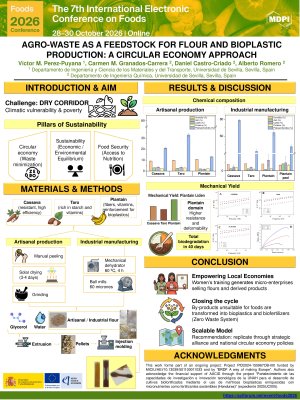
Introduction: The growing pressure to enhance food production while reducing associated environmental burdens has driven the development of more efficient and sustainable approaches. Recent advances in polymer science have focused on substituting conventional petroleum-based plastics with eco-friendly alternatives, following circular economy principles. The valorization of agro-industrial by-products for the production of food-grade flours and biodegradable bioplastics is proposed as an integrated strategy to reduce waste and improve technological innovation.
Materials and Methods: Surplus fractions from diverse crops were utilized as potential feedstocks. Flour production involved peeling and size reduction of raw materials to improve drying kinetics, followed by low-temperature dehydration to retain nutritional and functional properties. The flours were characterized in terms of composition and particle size distribution. Biopolymeric matrices were fabricated via injection moulding and subsequently evaluated using dynamic mechanical analysis and standardized biodegradability tests under controlled composting conditions.
Results: Flours derived from agro-industrial residues exhibited a heterogeneous particle size distribution, with a predominantly polysaccharide content. In contrast, protein-based bioplastics demonstrated suitable mechanical performance, including adequate tensile strength and elasticity. The materials showed effective biodegradation under composting conditions, with complete degradation within 30–40 days.
Conclusions: The valorization of agro-industrial surpluses into food-grade flours and biodegradable bioplastics represents a technically feasible and sustainable approach. This strategy supports circular economy models and contributes to addressing critical challenges related to food security and climate change mitigation.
Funding sources: This work forms part of an ongoing project: Project PID2024-155967OB-I00 funded by MICIU/AEI/10.13039/501100011033 and by “ERDF A way of making Europe”. Authors also acknowledge the financial support of Agencia Andaluza de Cooperación Internacional para el Desarrollo through the project “Fortalecimiento de las capacidades de investigación e innovación tecnológica de la UNAH para el desarrollo de cultivos biofortificados mediante el uso de matrices bioplásticas enriquecidas con micronutrientes como fertilizantes sostenibles (Honduras)” (expediente 2025UC005).
Keywords
Agro-waste
Bioplastics
Circular economy
Sustainability.
Poster
Foods poster_AgrowasteFeedstock_VMPP.pdf
Effect of Milk Thistle (Silybum marianum L.) Addition on the Quality and Nutritional Value of Rye Bread
Effects of Different Drying Methods on Bioactive Compounds and Antioxidant Capacity of Cushuro (Nostoc sphaericum)