Event submissions
Published
This submission belongs to the session B. Nutritional & Functional Foods of the event The 7th International Electronic Conference on Foods
Published date
23 Oct, 2026
Academic Editor
 Manuel Viuda-Martos
Citation
Frankzua Munive, Mayra Anticona, Effects of Different Drying Methods on Bioactive Compounds and Antioxidant Capacity of Cushuro (Nostoc sphaericum), in Proceedings of The 7th International Electronic Conference on Foods, 28 October–30 October 2026, MDPI: Basel, Switzerland
Share
Email
Facebook
Twitter
LinkedIn
Effects of Different Drying Methods on Bioactive Compounds and Antioxidant Capacity of Cushuro (Nostoc sphaericum)

Frankzua Munive 1

Mayra Anticona 1,2
1. Nutrition and Dietetics Program, Faculty of Health Sciences, San Ignacio de Loyola University, Lima, 15024, Peru
2. Research Unit in Nutrition, Health, Functional Foods and Nutraceuticals (UNUSAN–USIL), San Ignacio de Loyola University, Lima, 15024, Peru
Abstract
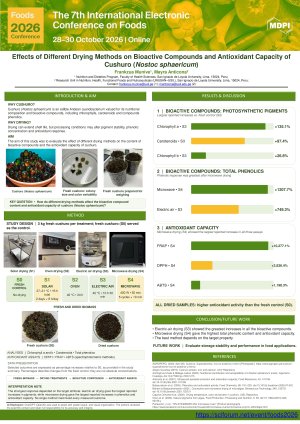
Introduction: Cushuro (Nostoc sphaericum) is an Andean cyanobacterium recognized for its nutritional value and its content of bioactive compounds, such as phenolic compounds, carotenoids, and chlorophylls, which are associated with antioxidant properties and potential health benefits. However, preservation processes, particularly drying, may modify the concentration and stability of these compounds. The aim of this study was to evaluate the effect of different drying methods on the content of bioactive compounds and the antioxidant capacity of cushuro.
Methodology: Three kilograms of fresh cushuro were allocated to each treatment. Four drying methods were evaluated: solar drying (S1; 27–31 °C, 2 days × 8 h/day, 08:00–16:00 h; total 16 h), oven drying (S2; 40 °C for 24 h), electric air drying (S3; 40 °C for 10 h 30 min), and microwave drying (S4; 400 W for 50 min in five 10-min cycles), with fresh cushuro as the control (S0). Chlorophylls, carotenoids, and total phenolic compounds were determined spectrophotometrically. Antioxidant capacity was evaluated using DPPH, FRAP, and ABTS assays. Results were expressed as relative percentages (%) using the maximum value for each parameter as the reference to facilitate comparison among drying treatments.
Results: Compared with the fresh sample (S0), chlorophyll content was higher in S3, reaching increases of 135.1% for chlorophyll a and 26.8% for chlorophyll b. Carotenoids also reached their highest value in S3, with a 97.4% increase compared with the control. In contrast, total phenolic compounds were highest in S4, with an increase of 1207.7%, followed by S3 with 749.3%. Regarding antioxidant capacity, S4 showed the greatest increases in the DPPH (2836.4%), FRAP (10277.1%), and ABTS (1198.3%) assays. All dried samples showed higher antioxidant activity than the fresh sample.
Conclusions: Drying methods significantly influenced the bioactive composition and antioxidant capacity of cushuro. Electric air drying favored the preservation of photosynthetic pigments, whereas microwave drying promoted higher concentrations of phenolic compounds and antioxidant activity. These findings suggest that selecting an appropriate drying method can optimize the functional properties of cushuro and enhance its potential as a value-added functional food.
Keywords
cushuro
Nostoc sphaericum
drying
bioactive compounds
antioxidant capacity.
Poster
Cushuro_Foods2026_Poster_Munive_and_Anticona.pdf
Agro-Waste as a Feedstock for Flour and Bioplastic Production: A Circular Economy Approach
Solar Radiation-Induced Senescence in Tropical Fruits: Mechanisms, Consequences, and Mitigation Strategies