Event submissions
Published
This submission belongs to the session E. Sustainable Food System & Food Security of the event The 7th International Electronic Conference on Foods
Published date
23 Oct, 2026
Academic Editor
 Theodoros Varzakas
Citation
Titilope Modupe Fasuan, Yemisi Omobonike Olagunju, Onaolapo Adeola Olatunji, Solar Radiation-Induced Senescence in Tropical Fruits: Mechanisms, Consequences, and Mitigation Strategies, in Proceedings of The 7th International Electronic Conference on Foods, 28 October–30 October 2026, MDPI: Basel, Switzerland
Share
Email
Facebook
Twitter
LinkedIn
Solar Radiation-Induced Senescence in Tropical Fruits: Mechanisms, Consequences, and Mitigation Strategies

Titilope Modupe Fasuan 1
Yemisi Omobonike Olagunju 2,3
Onaolapo Adeola Olatunji 4,5
1. Product Development Program, National Horticultural Research Institute, Ibadan, Nigeria
2. Biotechnology Department, National Horticultural Research Institute, Jericho, Idi-ishin, Oyo State, Nigeria
3. Department of Botany, University of Ibadan, Ibadan, Nigeria
4. Product Development Program, National Horticultural Research Institute, Jericho, Idi-ishin, Oyo State, Nigeria
5. Food Technology Department, University of Ibadan, Ibadan, Oyo state, Nigeria
Abstract
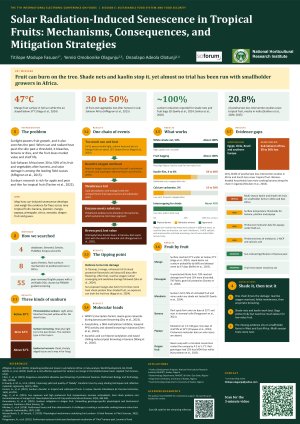
Sun-induced senescence in tropical fruits occurs when sunburn exceeds the photoprotective capacity of the epidermis. It accelerates post-harvest deterioration and worsens losses, which already run at 30 to 50% of total fruit production. This review synthesises the mechanism and consequences of solar radiation-induced senescence in major tropical fruits like banana (Musa acuminata and Musa balbisiana), plantain (Musa paradisiaca), mango (Mangifera indica), papaya (Carica papaya), pineapple (Ananas comosus), citrus (Citrus spp.), avocado (Persea americana), dragon fruit (Hylocereus spp.), and guava (Psidium guajava). This study also uncovered the mitigation interventions to abate the problem. Following the PRISMA workflow, eight thematic searches were conducted on four scholarly databases, resulting in 55 peer-reviewed articles used for this study. Results indicate that sunburn browning, photooxidative sunburn and epidermal necrosis are the three basic types of sun-induced senescence. These three types shared a mechanism for excess reactive oxygen species (ROS) generation that overwhelms both enzymatic and non-enzymatic antioxidant defences. Fruit surface temperatures above 46 to 52°C mark the most reliably documented induction point for sunburn browning. Once that threshold is crossed, membrane destabilisation follows. Mitigation strategies reviewed fall into three tiers. The first is agronomic and canopy management, which includes pruning, intercropping with shade-providing crops, and choosing rootstocks with high water supply capacity. The second is physical and microclimate interventions like using shading nets, fruit bagging, and evaporative cooling. The third strategy is biochemical and chemical approaches such as kaolin clay films, calcium carbonate, ascorbic acid, salicylic acid, 1-methylcyclopropene, and edible coatings. The identified gaps include the absence of species-specific thermal thresholds for most tropical fruits and the limited knowledge about how solar radiation interacts with the accumulation of extractable bioactive compounds in these species. Future studies need integrative multi-omics approaches and climate-adaptive management strategies calibrated to the real constraints of tropical production systems.
Keywords
Sunburn
tropical fruits
ROS
polyphenol oxidase
peel browning
postharvest senescence
Poster
Sunburn Senescence Poster A0.pdf
Effects of Different Drying Methods on Bioactive Compounds and Antioxidant Capacity of Cushuro (Nostoc sphaericum)
Consumer Values, Safety Perceptions, and Sustainable Vegetable Purchasing Behavior: A Cross-Sectional Study