Event submissions
Published
This submission belongs to the session E. Sustainable Food System & Food Security of the event The 7th International Electronic Conference on Foods
Published date
23 Oct, 2026
Academic Editor
 Theodoros Varzakas
Citation
Matheus Koengkan, José Alberto Fuinhas, Zakir Khan, Hélde Domingos, Muhammad Aqib Khursheed, Asymmetric Adjustment and Structural Change in the China–Brazil Soybean–Emissions Nexus, in Proceedings of The 7th International Electronic Conference on Foods, 28 October–30 October 2026, MDPI: Basel, Switzerland
Share
Email
Facebook
Twitter
LinkedIn
Asymmetric Adjustment and Structural Change in the China–Brazil Soybean–Emissions Nexus

Matheus Koengkan 1

José Alberto Fuinhas 2
Zakir Khan 3
Hélde Domingos 4
Muhammad Aqib Khursheed 5
1. Strategic Research and Services Unit for Agrarian and Forestry Systems and Plant Health (SAFSV), National Institute for Agrarian and Veterinary Research, I.P. (INIAV, I.P.), Oeiras, 2780-157, Portugal
2. University of Coimbra, Faculty of Economics, and Centre for Business and Economics Research (CeBER), 3004-531 Coimbra, Portugal
3. National Yunlin University of Science and Technology, Department of Business Administration, Douliu, Yunlin County, 640301, Taiwan
4. University of Brasília, Department of Economics, Brasília, Brazil
5. Department of Business Economics, Gabriele d’Annunzio University of Chieti-Pescara, Pescara, 66127, Italy.
Abstract
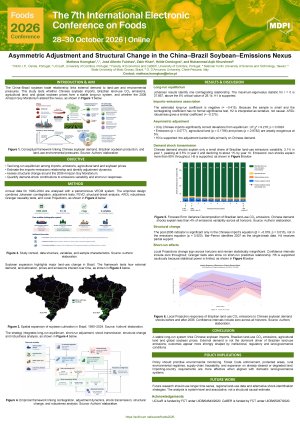
This study re-examines the relationship between Chinese soybean demand and Brazil’s land-use CO₂ emissions within a dynamic trade–environment system. While the dominant narrative links rising external demand to environmental degradation, existing empirical studies largely rely on static or reduced-form approaches that do not distinguish between short-run correlations and long-run equilibrium relationships, nor account for structural change. As a result, current evidence remains inconclusive regarding the persistence, direction, and adjustment dynamics of this nexus. To address this gap, the study integrates cointegration analysis, a Vector Error Correction Model (VECM), structural break testing, and Local Projections within a unified empirical framework, using annual data from 1990 to 2024. This approach allows the joint identification of long-run equilibrium relationships, asymmetric adjustment mechanisms, and policy-induced structural change. The results indicate the presence of a stable long-run equilibrium linking Chinese soybean imports, Brazilian land-use emissions, agricultural land, and global soybean prices. The estimated long-run relationship reveals a negative or weak conditional association between demand and emissions, consistent with system-level adjustments shaped by institutional constraints rather than a direct causal effect. Short-run dynamics are strongly asymmetric: Chinese imports adjust to restore equilibrium, while emissions behave as weakly exogenous. Structural break tests identify a regime shift around the 2006 Soy Moratorium, primarily affecting demand dynamics. Forecast error variance decomposition shows that demand shocks explain only a small share of emissions variability, while Local Projection estimates provide no robust evidence of short-run effects. Overall, the findings highlight that trade–environment interactions are governed by long-run system dynamics and domestic structural factors, with important implications for supply-chain governance and demand-side environmental policies.
Keywords
China–Brazil trade
soybean demand
land-use CO₂ emissions
cointegration
VECM
asymmetric adjustment
structural change
Soy Moratorium
telecoupling
environmental policy
Poster
Foods2026_Poster_China_Brazil_Soybean_Emissions_Artigo_2.pdf
Consumer Values, Safety Perceptions, and Sustainable Vegetable Purchasing Behavior: A Cross-Sectional Study
The One Health Gap in the Arab World: Diagnosing Governance Deficits through Brucellosis and Hepatitis A