Event submissions
Published
This submission belongs to the session E. Sustainable Food System & Food Security of the event The 7th International Electronic Conference on Foods
Published date
23 Oct, 2026
Academic Editor
 Theodoros Varzakas
Citation
Mauro Lombardo, Gender- and Age-Related Differences in Sustainable Dietary Transitions during a Mediterranean Diet Intervention, in Proceedings of The 7th International Electronic Conference on Foods, 28 October–30 October 2026, MDPI: Basel, Switzerland
Share
Email
Facebook
Twitter
LinkedIn
Gender- and Age-Related Differences in Sustainable Dietary Transitions during a Mediterranean Diet Intervention
Gender- and Age-Related Differences in Sustainable Dietary Transitions during a Mediterranean Diet Intervention

Mauro Lombardo 1
1. Department for the Promotion of Human Science and Quality of Life, San Raffaele Open University, Via di Val Cannuta, 247, 00166 Rome, Italy
Abstract
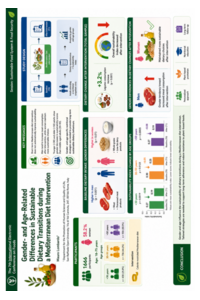
This study explored the influence of gender and age on sustainable dietary transitions during a Mediterranean diet intervention in adults attending a nutritional outpatient clinic. Sustainable eating patterns are increasingly recognized as important strategies for improving both human and environmental health; however, demographic factors may influence adherence to these dietary models.
1666 participants (58.2% women) aged 18–75 years followed a calorie-restricted Mediterranean dietary intervention, and food intake was evaluated before and after treatment using dietary questionnaires and a sustainability index. Changes in dietary habits were analysed according to sex and age groups (<30, 30–50, and >50 years).
At baseline, men reported higher consumption of meat and processed meat products (p < 0.001), whereas women consumed more whole grains and low-fat dairy products (p < 0.01). Following the intervention, legume consumption increased significantly (+3.2%, p < 0.001), although the overall sustainability index decreased in the total sample. Significant reductions in sustainability scores were observed in participants aged <30 years (0.27 vs. 0.19; p = 0.0019) and >50 years (0.27 vs. 0.19; p = 0.0005), while smaller changes were observed in the 30–50-year group (0.30 vs. 0.25; p = 0.0123). Men showed a greater tendency toward increased meat consumption after the intervention, whereas women maintained more sustainable dietary choices.
These findings suggest that short-term Mediterranean dietary interventions do not automatically improve sustainability-related behaviours, particularly in specific demographic groups. Gender- and age-specific nutritional strategies may therefore be necessary to facilitate long-term adherence to sustainable dietary patterns and reduce resistance to plant-based food choices.
Keywords
sustainability index
sustainable nutrition
food preferences
Mediterranean diet
dietary intervention
nutritional behaviour
gender differences
dietary patterns
plant-based foods
Poster
poster.pdf
The One Health Gap in the Arab World: Diagnosing Governance Deficits through Brucellosis and Hepatitis A
The use of freeze-dried black chokeberry pomace as a by-product in pork burgers