Event submissions
Published
This submission belongs to the session E. Sustainable Food System & Food Security of the event The 7th International Electronic Conference on Foods
Published date
23 Oct, 2026
Academic Editor
 Bimal Chitrakar
Citation
Aneta Cegiełka, Iwona Szymańska, Zuzanna Marszałek, The use of freeze-dried black chokeberry pomace as a by-product in pork burgers, in Proceedings of The 7th International Electronic Conference on Foods, 28 October–30 October 2026, MDPI: Basel, Switzerland
Share
Email
Facebook
Twitter
LinkedIn
The use of freeze-dried black chokeberry pomace as a by-product in pork burgers

Aneta Cegiełka 1

Iwona Szymańska 1
Zuzanna Marszałek 1
1. Department of Food Technology and Assesment, Institute of Food Sciences, Warsaw University of Life Sciences (WULS-SGGW), Warsaw, Poland
Abstract
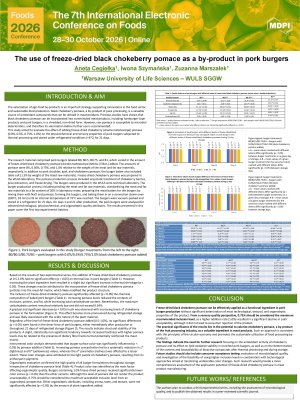
The aim of this study was to evaluate the effect of adding freeze-dried chokeberry (Aronia melanocarpa) pomace at levels of 0.0%, 0.5%, 0.75%, and 1.0% on the quality of pork burgers, marked as B0, B05, B075, and B1, respectively, subjected to heat treatment and storage (+4°C, 21 days). Chokeberry pomace was incorporated as a natural source of dietary fibre and bioactive compounds, as well as a means of valorizing chokeberry-processing by-products. Burgers were baked in a convection steam oven (180°C, 10 min) until an internal temperature of 72°C was reached and subsequently evaluated for selected physicochemical and organoleptic properties.
The addition of chokeberry pomace did not significantly affect (p > 0.05) thermal loss, although the difference between burgers B0 and B1 reached 3.6%. In contrast, pomace addition caused a significant increase in shrinkage (p < 0.05), with the difference between B0 and B1 amounting to 7.8%. Increasing the pomace level reduced the water, protein, and fat contents of burgers and significantly (p < 0.05) increased total carbohydrate content from 0.0% (B0 and B05) to 0.34% (B1). Despite small differences in pH values (maximum 0.05 units), increasing pomace addition resulted in a significant decrease in pH (p < 0.05).
Instrumental color analysis showed a significant (p < 0.05) decrease in lightness (L⁎) and yellowness (b⁎), whereas redness (a⁎) was not affected (p > 0.05) on day 1. Neither chokeberry pomace addition nor storage time significantly influenced burger shear force values (p > 0.05). Organoleptic evaluation indicated high quality of all burger variants, with scores of at least 3.9 points on a 5-point scale. However, burgers containing 1.0% pomace received lower color scores (p < 0.05) on days 1 and 21. The results indicate that the addition of freeze-dried chokeberry pomace should not exceed 0.75%, providing an effective strategy for by-product valorization while maintaining desirable burger quality attributes.
Keywords
chokeberry pomace
pork burgers
physicochemical properties
organolpeptic quality
food by-products
Poster
POSTER TEMPLATE 7th IEConference on Foods 2026.pdf
Gender- and Age-Related Differences in Sustainable Dietary Transitions during a Mediterranean Diet Intervention
From Ocean to Data: Digital Traceability for Sustainable Seafood Value Chains