Event submissions
Published
This submission belongs to the session B. Nutritional & Functional Foods of the event The 7th International Electronic Conference on Foods
Published date
23 Oct, 2026
Academic Editor
 Manuel Viuda-Martos
Citation
Ignacio Alvarez, Ramona del Carmen Maturano, Pamela Quintas, Paula Sette, Valorization of Grape Pomace for the extraction of phenolic compounds using Natural Deep Eutectic Solvents (NaDES), in Proceedings of The 7th International Electronic Conference on Foods, 28 October–30 October 2026, MDPI: Basel, Switzerland
Share
Email
Facebook
Twitter
LinkedIn
Valorization of Grape Pomace for the extraction of phenolic compounds using Natural Deep Eutectic Solvents (NaDES)

Ignacio Alvarez 1
Ramona del Carmen Maturano 1
Pamela Quintas 1
Paula Sette 1
1. Engineering Faculty, National Comahue University (UNCOma)/ National Scientific and Technical Research Council (CONICET)/ Institute for Research and Development in Process Engineering, Biotechnology, and Alternative Energies (PROBIEN), Neuquén, 8300, Argentina
Abstract
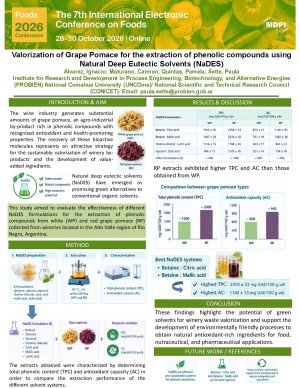
The wine industry generates substantial amounts of grape pomace, an agro-industrial by-product rich in phenolic compounds with recognized antioxidant and health-promoting properties. The recovery of these bioactive molecules represents an attractive strategy for the sustainable valorization of winery by-products and the development of value-added ingredients. Natural deep eutectic solvents (NaDES) have emerged as promising green alternatives to conventional organic solvents. This study aimed to evaluate the effectiveness of different NaDES formulations for the extraction of phenolic compounds from white (WP) and red grape pomace (RP) collected from wineries located in the Alto Valle region of Río Negro, Argentina. Eight NaDES formulations were prepared using naturally derived components: betaine, glucose, glycerol, choline chloride, citric acid, mallic acid, and lactic acid. Extractions were carried out at 60 °C under continuous stirring for 2h using both WP RP as raw materials. The extracts obtained were characterized by determining total phenolic content (TPC) and antioxidant capacity (AC) in order to compare the extraction performance of the different solvent systems. The results demonstrated that extraction efficiency was strongly influenced by NaDES composition. RP extracts exhibited higher TPC and AC than those obtained from WP. Among the evaluated solvent systems, the combination betaine: citric acid, and betaine: mallic acid showed the highest extraction performance, yielding extracts with superior TPC (2358 ± 23 mg gallic acid equivalents (GAE)/100 g wet basis (wb)) and AC (1140 ± 33 mg GAE/ 100 g wb). Overall, NaDES-based extraction constitutes an effective and sustainable approach for the recovery of phenolic compounds from grape pomace. These findings highlight the potential of green solvents for winery waste valorization and support the development of environmentally friendly processes to obtain natural antioxidant-rich ingredients for food, nutraceutical, and pharmaceutical applications.
Keywords
grape pomace
bioactive compounds
NaDES
extraction process
antioxidant capacity
Poster
Poster sciforum 198618.pdf
From Ocean to Data: Digital Traceability for Sustainable Seafood Value Chains
Assessment of protein oxidation in beef treated with pomegranate (Punica granatum L.) peel extract