Event submissions
Published
This submission belongs to the session G. Food Safety, Toxicology & Quality of the event The 7th International Electronic Conference on Foods
Published date
23 Oct, 2026
Academic Editor
 Esther Sendra
Citation
Arita Sabriu Haxhijaha, Njomza Luta Idrizi, Luzana Shabani, Vladimir Kitanovski, Olga Popovska, Monika Stojanova, Assessment of protein oxidation in beef treated with pomegranate (Punica granatum L.) peel extract, in Proceedings of The 7th International Electronic Conference on Foods, 28 October–30 October 2026, MDPI: Basel, Switzerland
Share
Email
Facebook
Twitter
LinkedIn
Assessment of protein oxidation in beef treated with pomegranate (Punica granatum L.) peel extract

Arita Sabriu Haxhijaha 1
Njomza Luta Idrizi 1
Luzana Shabani 2
Vladimir Kitanovski 1
Olga Popovska 1
Monika Stojanova 1
1. Department of Food Technology, Faculty of Technological Sciences, Mother Teresa University - Skopje, 1010, R. of North Macedonia
2. Department of Biology, Faculty of Natural Sciences and Mathematics, University of Tetova, Tetovo 1200, North Macedonia.
Abstract
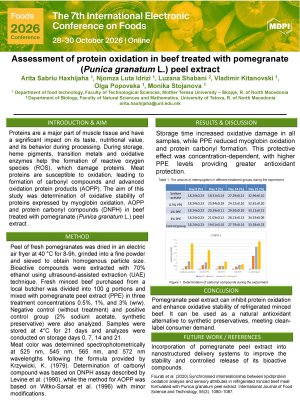
Introduction: Proteins are a major part of muscle tissue and have a significant impact on its taste, nutritional value, and its behavior during processing. During storage, heme pigments, transition metals and oxidative enzymes help the formation of reactive oxygen species (ROS), which damage proteins. Meat proteins are susceptible to oxidation, leading to formation of carbonyl compounds and advanced oxidation protein products (AOPP).
Methods: In our study, we investigated the oxidative stability of proteins in minced beef meat that was treated with pomegranate (Punica granatum L.) peel extract (PPE) during refrigerated storage at +4 °C for 21 days. The experimental design included a control sample, a positive control (treated with 0.2% sodium acetate), and samples treated with varying concentrations of PPE (0.5%, 1% and 3%). Protein oxidation was assessed at day 0, 7, 14, and 21, by determining myoglobin oxidation, AOPP, and protein carbonyl compounds.
Results and Discussions: Results showed that storage time significantly increased oxidative modifications in all samples; however, PPE-treated groups exhibited markedly lower levels of metmyoglobin formation, AOPP, and carbonyl compounds compared to the untreated control. The antioxidant efficacy of PPE was concentration-dependent, with higher extract levels providing better protection against oxidative deterioration.
Conclusions: These findings indicate that pomegranate peel extract can serve as a natural antioxidant alternative to synthetic preservatives, meeting clean-label consumer demand while effectively inhibiting protein oxidation and enhancing the oxidative stability and quality of refrigerated minced beef.
Keywords
Pomegranate peel extract
carbonyl compounds
AOPP
clean-label demand
Poster
FOODS 2026 poster Arita Sabriu Haxhijaha.pdf
Valorization of Grape Pomace for the extraction of phenolic compounds using Natural Deep Eutectic Solvents (NaDES)
SUGAR-FREE CAFFEINE GUMMIES ENRICHED WITH COLLAGEN AND PECTIN