Event submissions
Published
This submission belongs to the session G. Food Safety, Toxicology & Quality of the event The 7th International Electronic Conference on Foods
Published date
23 Oct, 2026
Academic Editor
 Esther Sendra
Citation
Josep Pages-Rebull, Clara Pérez-Ràfols, Núria Serrano, José Manuel Díaz-Cruz, Classification and Authentication of Flour by HPLC-UV and Chemometrics, in Proceedings of The 7th International Electronic Conference on Foods, 28 October–30 October 2026, MDPI: Basel, Switzerland
Share
Email
Facebook
Twitter
LinkedIn
Classification and Authentication of Flour by HPLC-UV and Chemometrics

Josep Pages-Rebull 1

Clara Pérez-Ràfols 1,2

Núria Serrano 1,2

José Manuel Díaz-Cruz 1,2
1. Department of Chemical Engineering and Analytical Chemistry, Universitat de Barcelona (UB), Martí i Franquès 1-11, 08028-Barcelona, Spain
2. Water Research Institute (IdRA), Universitat de Barcelona (UB), Martí i Franquès 1-11, 08028-Barcelona, Spain
Abstract
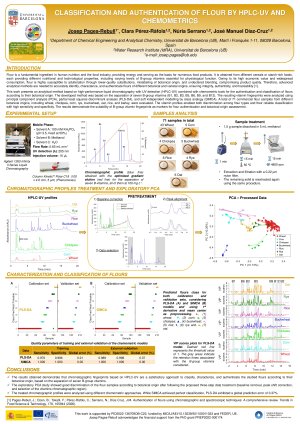
Flour is a fundamental ingredient in human nutrition and the food industry, providing energy and serving as the basis for numerous food products. It is obtained from different cereals or starch-rich foods, each providing different nutritional and technological properties, including varying levels of B-group vitamins essential for physiological function. Owing to its high economic value and widespread consumption, flour is highly susceptible to adulteration through lower-quality substitutions, mislabelling of botanical origin, and undeclared blending, compromising product quality. Therefore, advanced analytical methods are needed to accurately identify, characterize, and authenticate flours of different botanical and varietal origins, ensuring integrity, authenticity, and traceability.
This work presents an approach based on the combination of high-performance liquid chromatography with UV detection (HPLC-UV) and chemometric tools to obtain characteristic profiles of flours with multiple botanical origins (wheat, chickpea, corn, rye, buckwheat, oat, rice, and barley) based on the separation of B-group vitamins. Thus, an HPLC-UV method was developed to determine seven B-group vitamins (B1, B2, B3, B5, B6, B9, and B12), using a polar C18 reversed-phase column under a 20 min gradient elution with 40 mM KH2PO4 (pH 3.5) and methanol as mobile phase, with detection at 205 nm. A total of 71 flour samples were analysed and subjected to chemometric analysis, including principal component analysis (PCA), partial least squares discriminant analysis (PLS-DA), and soft independent modelling by class analogy (SIMCA), to evaluate classification according to botanical origin. PLS-DA provided sensitivities and specificities higher than 89% in calibration and 98% in external validation, whereas SIMCA achieved 100% sensitivity and specificity in both cases. Moreover, PLS-DA loading profiles revealed that chromatographic regions associated with vitamins B6, B3, B5, B9, and B2 were the main contributors to sample discrimination, demonstrating the suitability of B-group vitamin fingerprints for the authentication and classification of flours by botanical origin.
Keywords
flour
food authentication
liquid chromatography
chemometrics
Poster
Pages-Rebull_Josep_Poster.pdf
SUGAR-FREE CAFFEINE GUMMIES ENRICHED WITH COLLAGEN AND PECTIN
Fruit Peel Wastes as Potential Sources of Functional Ingredients with Antioxidant and Antimicrobial Activities