Event submissions
Published
This submission belongs to the session G. Food Safety, Toxicology & Quality of the event The 7th International Electronic Conference on Foods
Published date
23 Oct, 2026
Academic Editor
 Esther Sendra
Citation
Luana Malaquias Bertoleti, Caroline Simão, Vanderlei Aparecido Lima, Maria Lurdes Felsner, Digital Image Processing Coupled with Machine Learning for the Classification of Commercial Fruit Vinegars, in Proceedings of The 7th International Electronic Conference on Foods, 28 October–30 October 2026, MDPI: Basel, Switzerland
Share
Email
Facebook
Twitter
LinkedIn
Digital Image Processing Coupled with Machine Learning for the Classification of Commercial Fruit Vinegars

Luana Malaquias Bertoleti 1
Caroline Simão 1
Vanderlei Aparecido Lima 1,2

Maria Lurdes Felsner 1,3
1. Department of Chemistry, State University of Midwestern Paraná (UNICENTRO), Guarapuava 85040-167, Brazil.
2. Academic Department of Chemistry, Federal University of Technology - Paraná (UTFPR), Pato Branco 85503-390, Brazil.
3. Department of Chemistry, State University of Londrina (UEL), Londrina 86057-970, Brazil.
Abstract
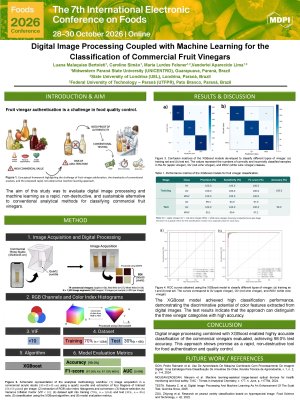
Fruit vinegars are highly appreciated for their unique aroma, flavor, organoleptic properties, and health benefits. Due to their high commercial value, they are particularly susceptible to fraud and adulteration. Since conventional quality control methods are often destructive, costly, and time-consuming, rapid and sustainable alternatives are needed. To address this, this study proposes validating an analytical methodology based on digital images, chemometrics, and machine learning to classify commercial fruit vinegars. A total of 79 commercial vinegars comprising apple (AV, n = 26), red wine (GV, n = 27), and white wine (WGV, n = 26) were analyzed. For model development, five images were acquired per sample, and four regions of interest (50 × 50 pixels) were selected per image, yielding 380 images and 1,520 image segments. Images were acquired under optimized conditions in a commercial photo studio (45 × 45 × 45 cm) with LED lighting, using a quartz cuvette at 8 cm with 100% light intensity. The images were processed using GIMP® and Chemostat® software. Color index histograms were used to build classification models, with variable selection performed via the variance inflation factor (< 10). The dataset (N = 1,520) was split into training (70%; n = 1,064) and test (30%; n = 456) sets. The XGBoost model achieved 100.0% training accuracy and 98.0% in external validation. For the visually similar classes, F1-scores of 97.05% (AV) and 97.18% (WGV) were obtained, with a mean AUC of 0.998. These results demonstrate that chromatic information extracted from digital images provides highly discriminative features, highlighting the potential of this integrated approach for commercial vinegar authentication and quality control.
Keywords
digital image analysis
food quality control
chemometrics
vinegar.
Poster
Foods_Caroline_Simao.pdf
Fruit Peel Wastes as Potential Sources of Functional Ingredients with Antioxidant and Antimicrobial Activities
Ready-to-drink upcycled coconut skim milk-pineapple blend: influence of formulation on physico-chemical properties and consumer acceptability