Event submissions
Published
This submission belongs to the session E. Sustainable Food System & Food Security of the event The 7th International Electronic Conference on Foods
Published date
23 Oct, 2026
Academic Editor
 Theodoros Varzakas
Citation
Chesedh E Cañete, Casiana Blanca J Villarino, Ready-to-drink upcycled coconut skim milk-pineapple blend: influence of formulation on physico-chemical properties and consumer acceptability, in Proceedings of The 7th International Electronic Conference on Foods, 28 October–30 October 2026, MDPI: Basel, Switzerland
Share
Email
Facebook
Twitter
LinkedIn
Ready-to-drink upcycled coconut skim milk-pineapple blend: influence of formulation on physico-chemical properties and consumer acceptability

Chesedh E Cañete 1

Casiana Blanca J Villarino 1
1. Department of Food Science and Nutrition, College of Home Economics, University of the Philippines Diliman, Quezon City 1101, Philippines
Abstract
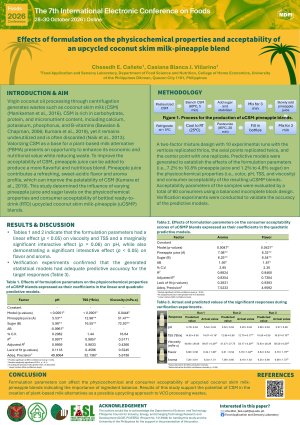
Virgin coconut oil processing through centrifugation generates wastes such as coconut skim milk (CSM). This by-product, despite its nutritional and health functional properties, remains underutilized and is often discarded. This study determined the influence of varying pineapple juice (%) and sugar (%) levels on the physicochemical properties (i.e., color, pH, total soluble solids or TSS and viscosity) and consumer acceptability of bottled ready-to- drink (RTD) upcycled coconut skim milk-pineapple (uCSMP) blend using a two-factor mixture design. Consumer acceptability tests (i.e., 9-pt hedonic scale) involved followed a balanced incomplete block design (i.e. Plan 11.15 of Cochran and Cox) involving a total of 60 consumers aged 18-59 years old. Predictive models were generated to establish the effects of the formulation parameters on the quality of the RTD uCSMP blends. Verification experiments were conducted to validate the accuracy of the predictive models. Formulation parameters exerted a linear effect (p < 0.05) on viscosity and total soluble solids, and a marginally significant interactive (p = 0.06) effect on the pH of the samples. In addition, the combination of pineapple juice and sugar exerted a significant (p < 0.05) interactive effect on the flavor and aroma acceptability of the RTD blends. Verification experiments confirmed that the generated statistical models had adequate predictive accuracy for the responses. The findings of this research demonstrate the potential of utilizing CSM in developing plant-based milk alternatives such as flavored uCSM blends to minimize the industrial waste generated from virgin coconut oil processing.
Keywords
upcycled coconut skim milk
pineapple
plant-based milk alternatives
physico-chemical properties
acceptability
mixture design
Poster
Foods 2026 Canete and Villarino - revised.pdf
Digital Image Processing Coupled with Machine Learning for the Classification of Commercial Fruit Vinegars
Oleogel-Based W/O Emulgels as Fat Replacers in Dough Systems: Rheological and Structural Characterization