Event submissions
Published
This submission belongs to the session B. Nutritional & Functional Foods of the event The 7th International Electronic Conference on Foods
Published date
23 Oct, 2026
Academic Editor
 Manuel Viuda-Martos
Citation
Neuvis Alejandro Pino, Marcelo Gomes Soares, Victor Guilherme, Priscila de Freitas Santos, Lucas Marchetti, Caroline Joy Steel, Rosiane Lopes Cunha, Gabriel Lorenzo, Oleogel-Based W/O Emulgels as Fat Replacers in Dough Systems: Rheological and Structural Characterization, in Proceedings of The 7th International Electronic Conference on Foods, 28 October–30 October 2026, MDPI: Basel, Switzerland
Share
Email
Facebook
Twitter
LinkedIn
Oleogel-Based W/O Emulgels as Fat Replacers in Dough Systems: Rheological and Structural Characterization

Neuvis Alejandro Pino 1
Marcelo Gomes Soares 2
Victor Guilherme 2
Priscila de Freitas Santos 2
Lucas Marchetti 1
Caroline Joy Steel 2
Rosiane Lopes Cunha 2
Gabriel Lorenzo 1
1. Centro de Investigación y Desarrollo en Ciencia y Tecnología de los Alimentos (CIDCA), Consejo Nacional de Investigaciones Científicas y Técnicas (CONICET), La Plata, B1900AJJ, Argentina
2. School of Food Engineering, University of Campinas, Campinas, 13083-862, Brazil
Abstract
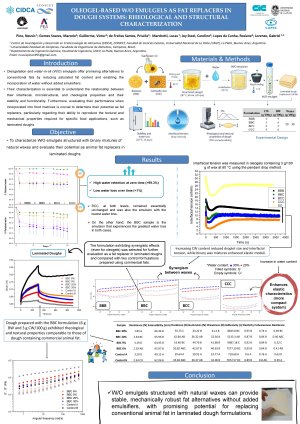
The growing demand for healthier food options has driven the development of functional ingredients aimed at reducing saturated and/or trans fat content without compromising product quality. In this context, oleogelation has emerged as a promising strategy to structure liquid oils without altering their degree of unsaturation. More recently, the formulation of W/O emulgels has been explored, enabling a reduction in caloric content while eliminating the need for added emulsifiers. This study aimed to characterize W/O emulgels and to evaluate their applications as fat replacers in laminated doughs. Thus, emulsions containing 20 and 30 g of water/100 g were developed using oleogel as the continuous phase, structured with binary mixtures of beeswax (BW) and carnauba wax (CW) (9 g/100 g). Emulsification was carried out at 90 °C, followed by rapid cooling. Storage stability (20 °C, 15 days), interfacial tension, microstructure, and rheological properties were evaluated. The emulsions incorporated up to 99.7% of the initial water, with losses below 1% during storage. Microscopy and interfacial tension measurements revealed a significant decrease in droplet size and interfacial tension when CW content was increased, suggesting the presence of naturally occurring surface-active compounds in the waxes. Additionally, binary mixtures exhibited higher elastic moduli compared to systems structured with individual waxes. The emulgels with 6 g BW and 3 g CW/100 g (BBC), were used as a fat replacer in a standard laminated pastry dough formulation (20g fat/100g flour). Rheological and textural properties (TPA and extensibility) of the doughs were similar to those of a formulation using a commercial animal fat. These findings demonstrate the feasibility of producing stable and mechanically robust water-in-oil (W/O) emulgels without added emulsifiers, capable of mimicking the animal fat in laminated dough formulations.
Keywords
Oleogelation
Water-in-oil emulsions (W/O)
Fat replacers
Binary wax mixtures
Rheology.
Poster
Poster Foods - Doughs.pdf
Ready-to-drink upcycled coconut skim milk-pineapple blend: influence of formulation on physico-chemical properties and consumer acceptability
Occurrence of Per- and Polyfluoroalkyl Substances (PFAS) in Small Pelagic Fish from the Adriatic Sea: Evidence of PFOS Dominance