Event submissions
Published
This submission belongs to the session G. Food Safety, Toxicology & Quality of the event The 7th International Electronic Conference on Foods
Published date
23 Oct, 2026
Academic Editor
 Esther Sendra
Citation
Jelena Kaurinović, Nina Bilandžić, Ines Varga, Maja Đokić, Ivana Varenina, Božica Solomun Kolanović, Marija Sedak, Bruno Čalopek, Slavica Čolak, Bosiljka Mustać, Bruna Petani, Natalija Džafić, Dijana Mišetić Ostojić, Kristina Kvrgić, Ivana Ujević, Tanja Bogdanović, Sandra Petričević, Occurrence of Per- and Polyfluoroalkyl Substances (PFAS) in Small Pelagic Fish from the Adriatic Sea: Evidence of PFOS Dominance, in Proceedings of The 7th International Electronic Conference on Foods, 28 October–30 October 2026, MDPI: Basel, Switzerland
Share
Email
Facebook
Twitter
LinkedIn
Occurrence of Per- and Polyfluoroalkyl Substances (PFAS) in Small Pelagic Fish from the Adriatic Sea: Evidence of PFOS Dominance

Jelena Kaurinović 1
Nina Bilandžić 1
Ines Varga 1
Maja Đokić 1
Ivana Varenina 1
Božica Solomun Kolanović 1
Marija Sedak 1
Bruno Čalopek 1
Slavica Čolak 2
Bosiljka Mustać 2
Bruna Petani 2
Natalija Džafić 3
Dijana Mišetić Ostojić 3
Kristina Kvrgić 3
Ivana Ujević 4
Tanja Bogdanović 5
Sandra Petričević 5
1. Croatian Veterinary Institute, Department of Veterinary Public Health, Laboratory for Residue Control, Zagreb, Croatia
2. University in Zadar, Department of Ecology, Agronomy and Aquaculture, Trg kneza Višeslava 9, 23000 Zadar, Croatia
3. Croatian Veterinary Institute, Veterinary Institute Rijeka, Laboratory for Microbiology and Analytical Chemistry, Rijeka, Croatia
4. Institute of Oceanography and Fisheries, Laboratory for Plankton and Shellfish Toxicity, Split, Croatia
5. Croatian Veterinary Institute, Veterinary Institute Split, Laboratory for Microbiology and Analytical Chemistry, Split, Croatia
Abstract
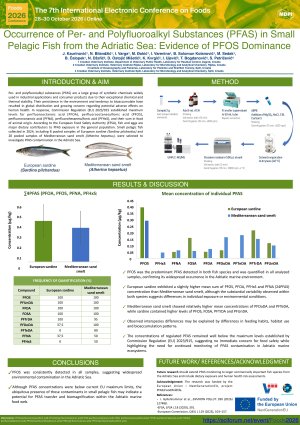
Per- and polyfluoroalkyl substances (PFAS) are a large group of synthetic chemicals widely used in industrial applications and consumer products due to their exceptional chemical and thermal stability. Their persistence in the environment and tendency to bioaccumulate have resulted in global distribution and growing concern regarding potential adverse effects on human health. In response, Commission Regulation (EU) 2023/915 established maximum levels for perfluorooctanoic acid (PFOA), perfluorooctanesulfonic acid (PFOS), perfluorononanoic acid (PFNA), perfluorohexanesulfonic acid (PFHxS), and their sum in food of animal origin. According to the European Food Safety Authority (EFSA), fish and eggs are major dietary contributors to PFAS exposure in the general population.
Small pelagic fish, including European sardine (Sardina pilchardus) and Mediterranean sand smelt (Atherina hepsetus), were selected to investigate PFAS contamination in the Adriatic Sea. Specimens collected in 2024 were analyzed following extraction with acetonitrile and dispersive solid-phase extraction (dSPE) clean-up. PFAS concentrations were determined using ultra-high-performance liquid chromatography coupled with tandem mass spectrometry (UHPLC-MS/MS).
PFOS was detected in all samples and was the dominant compound in both species. Concentrations ranged from 0.177 to 0.537 μg/kg in Mediterranean sand smelt and from 0.269 to 0.675 μg/kg in European sardine. PFHxS and PFNA were detected only in a subset of samples, while PFOA was not detected. The sum of regulated PFAS ranged from 0.177 to 0.655 μg/kg in sand smelt and from 0.269 to 0.726 μg/kg in sardine. Several long-chain PFAS, including FOSA, PFDA, and PFUnDA, were also identified in both species.
PFOS was consistently detected in all samples, suggesting widespread environmental contamination in the Adriatic Sea. As small pelagic fish constitute key prey for higher trophic-level organisms, these findings may indicate a potential risk for PFAS transfer and biomagnification within the marine food web.
Keywords
PFAS
PFOS
POPs
Sardina pilchardus
Atherina hepsetus
Adriatic Sea
pelagic fish
UHPLC-MS/MS
Poster
poster-foods-online-001.pdf
Oleogel-Based W/O Emulgels as Fat Replacers in Dough Systems: Rheological and Structural Characterization
Optimization of the sous-vide cooking process in pumpkin and carrot puree using response surface methodology