Event submissions
Published
This submission belongs to the session B. Nutritional & Functional Foods of the event The 7th International Electronic Conference on Foods
Published date
23 Oct, 2026
Academic Editor
 Manuel Viuda-Martos
Citation
Silvana Cecilia Ruiz, Diego Gutierrez, Julio Federico Benites, Silvia del Carmen Rodriguez, Optimization of the sous-vide cooking process in pumpkin and carrot puree using response surface methodology, in Proceedings of The 7th International Electronic Conference on Foods, 28 October–30 October 2026, MDPI: Basel, Switzerland
Share
Email
Facebook
Twitter
LinkedIn
Optimization of the sous-vide cooking process in pumpkin and carrot puree using response surface methodology

Silvana Cecilia Ruiz 1,2

Diego Gutierrez 2,3
Julio Federico Benites 2
Silvia del Carmen Rodriguez 2,3
1. Estación Experimental Agropecuaria Santiago del Estero, Instituto Nacional de Tecnología Agropecuaria, Santiago del Estero, 4200, Argentina
2. Instituto de Ciencia y Tecnología de los Alimentos. Facultad de Agronomía y Agroindustrias, Universidad Nacional de Santiago del Estero (UNSE), Santiago del Estero, 4200, Argentina
3. CIBAAL CONICET-UNSE, Villa El Zanjón, Santiago del Estero, Santiago del Estero, 4206, Argentina
Abstract
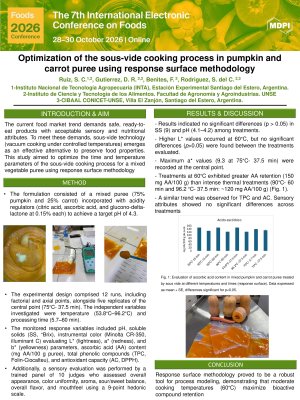
The current food market trend demands safe, ready-to-eat products with acceptable sensory and nutritional attributes. To meet these demands, sous-vide technology (vacuum cooking under controlled temperatures) emerges as an effective alternative to preserve food properties. This study aimed to optimize the time and temperature parameters of the sous-vide cooking process for a mixed vegetable puree using response surface methodology. The formulation consisted of a mixed puree (75% pumpkin and 25% carrot) incorporated with acidity regulators (citric acid, ascorbic acid, and glucono-delta-lactone at 0.15% each) to achieve a target pH of 4.3. The experimental design comprised 12 runs, including factorial and axial points, alongside five replicates of the central point (75°C- 37.5 min). The independent variables investigated were temperature (53.8°C–96.2°C) and processing time (5.7–60 min). The monitored response variables included pH, soluble solids (SS, °Brix), instrumental color (Minolta CR-350, illuminant C) evaluating L* (lightness), a* (redness), and b* (yellowness) parameters, ascorbic acid (AA) content (mg AA/100 g puree), total phenolic compounds (TPC, Folin-Ciocalteu), and antioxidant capacity (AC, DPPH). Additionally, a sensory evaluation was performed by a trained panel of 10 judges who assessed overall appearance, color uniformity, aroma, sour/sweet balance, overall flavor, and mouthfeel using a 9-point hedonic scale. Results indicated no significant differences (p > 0.05) in SS (9) and pH (4.1–4.2) among treatments. Higher L* values occurred at 60°C, whereas maximum a* values (9.3) were recorded at the central point. Treatments at 60°C exhibited greater AA retention (150 mg AA/100 g) than intense thermal treatments (90°C- 60 min and 96.2 °C- 37.5 min: ~120 mg AA/100 g). A similar trend was observed for TPC and AC. Sensory attributes showed no significant differences across treatments. Response surface methodology proved to be a robust tool for process modeling, demonstrating that moderate cooking temperatures (60°C) maximize bioactive compound retention.
Keywords
Pumpkin and carrot puree
response surface methodology
sous vide cooking
Poster
Optimization of the sous-vide cooking process.pdf
Occurrence of Per- and Polyfluoroalkyl Substances (PFAS) in Small Pelagic Fish from the Adriatic Sea: Evidence of PFOS Dominance
Fatty Acid Composition and Nutritional Quality of Marine Fish Species from the West African Coast