Event submissions
Published
This submission belongs to the session B. Nutritional & Functional Foods of the event The 7th International Electronic Conference on Foods
Published date
23 Oct, 2026
Academic Editor
 Manuel Viuda-Martos
Citation
Marisa Nicolai, Manuela Lageiro, Hermenegildo Robalo, Iça Barri, Paula Pereira, Fatty Acid Composition and Nutritional Quality of Marine Fish Species from the West African Coast, in Proceedings of The 7th International Electronic Conference on Foods, 28 October–30 October 2026, MDPI: Basel, Switzerland
Share
Email
Facebook
Twitter
LinkedIn
Fatty Acid Composition and Nutritional Quality of Marine Fish Species from the West African Coast

Marisa Nicolai 1

Manuela Lageiro 2,3,4

Hermenegildo Robalo 5
Iça Barri 5

Paula Pereira 1,6,7
1. CBIOS—Research Center for Biosciences & Health Technologies, Universidade Lusófona, Campo Grande 376, 1749-024 Lisboa, Portugal
2. INIAV—Instituto Nacional de Investigação Agrária e Veterinária, Unidade de Tecnologia e Inovação, 2780-157 Oeiras, Portugal
3. FCT-NOVA, Faculdade de Ciências e Tecnologia, Universidade Nova de Lisboa, 2829‐516 Caparica, Portugal
4. GeoBioTech Research Center, FCT-NOVA, Campus da Caparica, 2829-516 Caparica, Portugal
5. INIPO - Instituto Nacional de Investigação, Pesquisa e Oceanografia, Avenida 03 de Agosto, BP 102Bissau, Guiné-Bissau
6. EPCV, School of Psychology and Life Science, Department of Life Sciences, Universidade Lusófona, Campo Grande 376, 1749-024 Lisboa, Portugal
7. CERENA, Center for Natural Resources and Environment, Instituto Superior Técnico (IST), Universidade de Lisboa, Av. Rovisco Pais, 1049-001 Lisboa, Portugal
Abstract
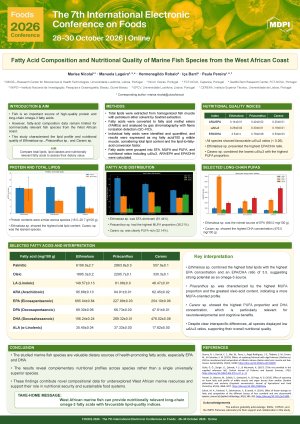
Introduction: Fish represents an important dietary source of high-quality protein and long-chain omega-3 polyunsaturated fatty acids (PUFAs), which are associated with cardiovascular, cognitive, and metabolic health benefits. However, information regarding the lipid composition of several commercially important fish species from the West African coast remains scarce. This study aimed to characterize the fatty acid profile and nutritional quality of three marine fish species, Ethmalosa sp., Priacanthus sp., and Caranx sp., collected along the West African coast.
Methods: Total lipids were extracted and fatty acid methyl esters were analysed by gas chromatography with flame ionization detection (GC–FID). Individual fatty acids were quantified and grouped into saturated fatty acids (SFAs), monounsaturated fatty acids (MUFAs), and polyunsaturated fatty acids (PUFAs). Nutritional quality indices, including ω6/ω3, ARA/EPA, and EPA/DHA ratios, were also calculated.
Results and Discussion: Marked interspecific differences were observed in lipid composition. Ethmalosa sp. showed the highest concentration of eicosapentaenoic acid (EPA; 695.0 mg/100 g), with an EPA/DHA ratio of 3.54, indicating a particularly rich source of marine omega-3 fatty acids. Priacanthus sp. presented intermediate PUFA levels (11.0%) and the highest proportion of monounsaturated fatty acids (36.2%). In contrast, Caranx sp. exhibited the highest PUFA content (32.1%), together with the greatest concentration of docosahexaenoic acid (DHA; 476.0 mg/100 g). All species displayed favourable ω6/ω3 ratios (<0.23), highlighting their nutritional value and potential contribution to a balanced diet.
Conclusions: The studied fish species constitute valuable dietary sources of health-promoting fatty acids, particularly EPA and DHA. These findings provide novel compositional data for underexplored West African marine resources and support their role in promoting nutritional security and sustainable food systems.
Keywords
Ethmalosa sp.
Priacanthus sp.
Caranx sp.
fatty acid profile
omega-3 fatty acids
EPA
DHA
nutritional quality
marine fish
food security.
Poster
Poster template Foods 2026.pdf
Optimization of the sous-vide cooking process in pumpkin and carrot puree using response surface methodology
How Well Do You Know the Gluten-Free Products?