Event submissions
Published
This submission belongs to the session G. Food Safety, Toxicology & Quality of the event The 7th International Electronic Conference on Foods
Published date
23 Oct, 2026
Academic Editor
 Esther Sendra
Citation
Mina Janković, Ivana Beara, Ljilja Torović, How Well Do You Know the Gluten-Free Products?, in Proceedings of The 7th International Electronic Conference on Foods, 28 October–30 October 2026, MDPI: Basel, Switzerland
Share
Email
Facebook
Twitter
LinkedIn
How Well Do You Know the Gluten-Free Products?

Mina Janković 1
Ivana Beara 2

Ljilja Torović 3
1. Department of General Education Subjects, Faculty of Medicine, University of Novi Sad, Novi Sad 21000, Serbia
2. Department of Chemistry, Biochemistry and Environmental Protection, Faculty of Sciences, University of Novi Sad, Novi Sad 21000, Serbia
3. Department of Pharmacy, Faculty of Medicine, University of Novi Sad, Novi Sad 21000, Serbia
Abstract
A strict gluten-free diet (GFD) depends on the accurate identification of both gluten-containing and gluten-free products. Misconceptions regarding product suitability may compromise dietary adherence and increase the risk of inadvertent gluten exposure. This study aimed to evaluate the knowledge and perceptions of food and non-food product suitability among individuals following a GFD.
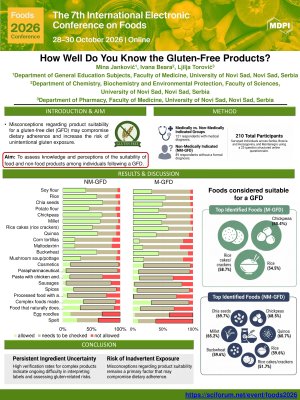
A prospective cross-sectional study was conducted using a structured 22-question online questionnaire administered to individuals adhering to a GFD in Serbia, Bosnia and Herzegovina, and Montenegro. Participants were stratified according to the reason for following a GFD into a medically indicated group (M-GFD) and a non-medically indicated group (NM-GFD).
Among the 210 respondents, 121 reported following a GFD for medically confirmed reasons, whereas 89 adhered to the diet without a formal medical diagnosis. Participants in both groups recognized the importance of verifying product suitability, although this practice was more pronounced among M-GFD respondents, suggesting greater dietary vigilance. In the NM-GFD group, product verification was most frequently reported for parapharmaceutical products (89.9%), cosmetics (84.3%), sausages (78.7%), spices (74.2%), and processed foods with complex ingredient lists (68.5%). Similar findings were observed in the M-GFD group, where the highest proportions were reported for spices (87.6%), parapharmaceutical products (86.0%), sausages (79.3%), and cosmetics (78.5%). Perceptions of foods suitable for a GFD were generally comparable between groups. In the NM-GFD group, chia seeds (69.7%), chickpeas (68.5%), millet (65.2%), quinoa (60.7%), buckwheat (59.6%), rice (59.6%), and rice cakes/crackers (51.7%) were most frequently identified as suitable. Likewise, M-GFD participants most commonly recognized rice cakes/crackers (58.7%), chickpeas (55.4%), and rice (54.5%) as appropriate gluten-free options.
Overall, respondents demonstrated awareness of the need to assess product suitability when following a GFD. However, verification efforts were predominantly focused on products with complex formulations, indicating persistent uncertainty regarding ingredient interpretation and the assessment of gluten-related risks.
Funding: AP Vojvodina Provincial Secretariat for Higher Education and Scientific Research, Grant No. 003862016 2025 09418 003 000 000 001 04 004
Keywords
gluten-free
celiac disease
public health
questionnaire
Poster
Foods 2026_GFD quiz_Mina Jankovic.pdf
Fatty Acid Composition and Nutritional Quality of Marine Fish Species from the West African Coast
Advances in the design and optimization of a functional purée for sous vide processing