Event submissions
Published
This submission belongs to the session B. Nutritional & Functional Foods of the event The 7th International Electronic Conference on Foods
Published date
23 Oct, 2026
Academic Editor
 Manuel Viuda-Martos
Citation
Silvana Cecilia Ruiz, Diego Gutierrez, Julio Federico Benites, Silvia del Carmen Rodriguez, Advances in the design and optimization of a functional purée for sous vide processing, in Proceedings of The 7th International Electronic Conference on Foods, 28 October–30 October 2026, MDPI: Basel, Switzerland
Share
Email
Facebook
Twitter
LinkedIn
Advances in the design and optimization of a functional purée for sous vide processing

Silvana Cecilia Ruiz 1,2

Diego Gutierrez 2,3
Julio Federico Benites 2
Silvia del Carmen Rodriguez 2,3
1. Estación Experimental Agropecuaria Santiago del Estero, Instituto Nacional de Tecnología Agropecuaria, Santiago del Estero, 4200, Argentina
2. Instituto de Ciencia y Tecnología de los Alimentos. Facultad de Agronomía y Agroindustrias, Universidad Nacional de Santiago del Estero (UNSE), Santiago del Estero, 4200, Argentina
3. CIBAAL CONICET-UNSE, Villa El Zanjón, Santiago del Estero, Santiago del Estero, 4206, Argentina
Abstract
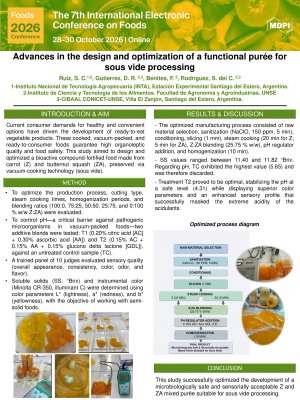
Current consumer demands for healthy and convenient options have driven the development of ready-to-eat vegetable products. These cooked, vacuum-packed, and ready-to-consumer foods guarantee high organoleptic quality and food safety. This study aimed to design and optimized a bioactive compound-fortified food made from carrot (Z) and butternut squash (ZA), preserved via vacuum-cooking technology (sous vide). To optimize the production process, cutting type, steam cooking times, homogenization periods, and blending ratios (100:0, 75:25, 50:50, 25:75, and 0:100 % w/w Z:ZA) were evaluated. To control pH—a critical barrier against pathogenic microorganisms in vacuum-packed foods—two additive blends were tested: T1 (0.20% citric acid [AC] + 0.30% ascorbic acid [AA]) and T2 (0.15% AC + 0.15% AA + 0.15% glucono delta lactone [GDL]), against an untreated control sample (TC). A trained panel of 10 judges evaluated sensory quality (overall appearance, consistency, color, odor, and flavor). Furthermore, soluble solids (SS, °Brix) and instrumental color (Minolta CR-350, illuminant C) were determined using color parameters L* (lightness), a* (redness), and b* (yellowness). The optimized manufacturing process consisted of raw material selection, sanitization (NaClO, 150 ppm, 5 min), conditioning, slicing (1 mm), steam cooking (20 min for Z; 5 min for ZA), Z:ZA blending (25:75 % w/w), pH regulator addition, and homogenization (10 min). SS values ranged between 11.40 and 11.82 °Brix. Regarding pH, TC exhibited the highest value (5.65) and was therefore discarded. Treatment T2 proved to be optimal, stabilizing the pH at a safe level (4.31) while displaying superior color parameters and an enhanced sensory profile that successfully masked the extreme acidity of the acidulants. Consequently, this study successfully optimized the development of a microbiologically safe and sensorially acceptable Z and ZA mixed purée suitable for sous vide processing.
Keywords
Functional mixed purée
butternut squash
carrot
Poster
Advances in the design and optimization.pdf
How Well Do You Know the Gluten-Free Products?
Beyond the Gluten-Free Trend: Attitudes and Knowledge Among the General Population