Event submissions
Published
This submission belongs to the session G. Food Safety, Toxicology & Quality of the event The 7th International Electronic Conference on Foods
Published date
23 Oct, 2026
Academic Editor
 Esther Sendra
Citation
Mina Janković, Ivana Beara, Ljilja Torović, Beyond the Gluten-Free Trend: Attitudes and Knowledge Among the General Population, in Proceedings of The 7th International Electronic Conference on Foods, 28 October–30 October 2026, MDPI: Basel, Switzerland
Share
Email
Facebook
Twitter
LinkedIn
Beyond the Gluten-Free Trend: Attitudes and Knowledge Among the General Population

Mina Janković 1
Ivana Beara 2

Ljilja Torović 3
1. Department of General Education Subjects, Faculty of Medicine, University of Novi Sad, Novi Sad 21000, Serbia
2. Department of Chemistry, Biochemistry and Environmental Protection, Faculty of Sciences, University of Novi Sad, Novi Sad 21000, Serbia
3. Department of Pharmacy, Faculty of Medicine, University of Novi Sad, Novi Sad 21000, Serbia
Abstract
One of the most common challenges faced by individuals on strict diets is social exclusion. In this context, increasing public awareness of the gluten-free diet (GFD) is especially important, given its role as the main treatment for gluten-related disorders like celiac disease (CD).
A prospective cross-sectional study was conducted using an online questionnaire distributed via the Internet among individuals from Serbia, Bosnia and Herzegovina, and Montenegro who did not follow a GFD. The study aimed to evaluate their awareness, knowledge, and attitudes toward the GFD.
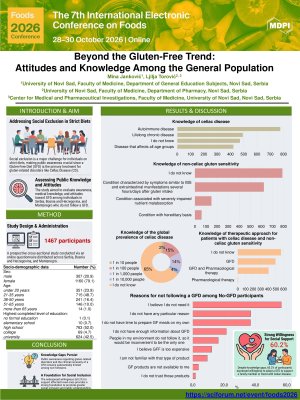
A total of 1,467 participants were enrolled (1,160 females, 307 males), predominantly aged 21–35 years, with most having secondary (763) or university education (624). Food allergies were reported by 68 participants, while 19.0% had followed or were following a specific diet. Regarding GFD, 29.0% considered it unnecessary for themselves, 19.0% reported lack of time for meal preparation as a barrier, and 18.9% provided no particular reason for not following it. Knowledge of celiac disease was limited, with 32.1% of participants being unfamiliar with the condition and only 16.8% providing a completely correct definition. The most commonly recognized characteristics of CD were its autoimmune nature (775), chronic lifelong course (493), and occurrence across all age groups (422). Awareness of non-celiac gluten sensitivity was considerably lower, as 53.8% of respondents had never heard of the condition and only 1.7% correctly identified it. Furthermore, only one-third of participants recognized GFD as the primary treatment for CD. Nevertheless, a positive attitude toward social support was observed, with 60.2% of participants expressing willingness to adopt a GFD to support a family member or friend with CD.
Although awareness of gluten-related disorders and the GFD remains limited, widespread willingness to support affected family members provides a promising foundation for promoting greater social inclusion and understanding for those following this diet.
Funding: AP Vojvodina Provincial Secretariat for Higher Education and Scientific Research, Grant No. 003862016 2025 09418 003 000 000 001 04 004
Keywords
gluten-free diet
celiac disease
public health
questionnaire
Poster
Foods 2026_GFD No-GFD_Mina Jankovic.pdf
Advances in the design and optimization of a functional purée for sous vide processing
A Sustainable Route to Functional Food Ingredients