Event submissions
Published
This submission belongs to the session B. Nutritional & Functional Foods of the event The 7th International Electronic Conference on Foods
Published date
23 Oct, 2026
Academic Editor
 Manuel Viuda-Martos
Citation
Paloma Franco, José Luis Navarro, Sol Auchterlonie, Paula Mariana Cortés Pincheira, Alberto Edel León, María Eugenia Steffolani, Influence of sprouting conditions on compositional changes and techno-functional properties of adzuki bean (Vigna angularis) flours, in Proceedings of The 7th International Electronic Conference on Foods, 28 October–30 October 2026, MDPI: Basel, Switzerland
Share
Email
Facebook
Twitter
LinkedIn
Influence of sprouting conditions on compositional changes and techno-functional properties of adzuki bean (Vigna angularis) flours

Paloma Franco 1
José Luis Navarro 1,2
Sol Auchterlonie 1
Paula Mariana Cortés Pincheira 1,2
Alberto Edel León 1,2
María Eugenia Steffolani 1,2
1. Instituto de Ciencia y Tecnología de los Alimentos Córdoba (ICYTAC, CONICET-UNC), Córdoba 5000, Argentina.
2. Facultad de Ciencias Agropecuarias, Universidad Nacional de Córdoba (UNC), Córdoba 5000, Argentina.
Abstract
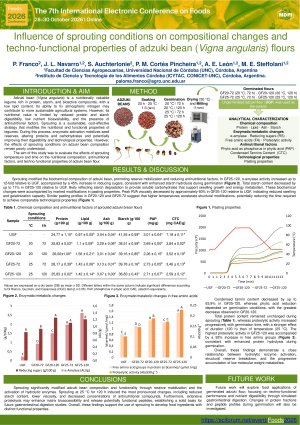
Germination is a biotechnological strategy capable of inducing metabolic changes that modify the chemical composition and functional properties of pulses. This study evaluated the effect of germination conditions on the compositional and techno-functional characteristics of adzuki bean (Vigna angularis) flours. Grains were soaked and germinated at different temperatures (20 or 25 °C) and time periods (72 or 120 h). After drying and milling, the germinated flours (GF20-72, GF20-120, GF25-72, and GF25-120) were compared with ungerminated adzuki flour (UGF). Proximate composition, α-amylase activity, reducing sugars, free amino acids, dietary fiber, phytic acid, condensed tannins, and RVA pasting properties were evaluated.
Germination promoted the mobilization of starch reserves, as evidenced by a reduction in starch content from 41 to 36 g/100 g, together with up to a 12-fold increase in α-amylase activity and a 45% increase in reducing sugars. The most pronounced effects were observed in GF25-120. These changes were associated with a marked reduction in pasting parameters. Peak viscosity decreased from 1123 cP in UGF to 460 cP in GF25-120, representing a reduction of nearly 60%. Although total protein content remained unchanged, free amino acid levels increased by up to 94%, with the highest values observed in GF25-120. In addition, germination reduced insoluble dietary fiber content by up to 30% and condensed tannin content by up to 60%, whereas phytic acid reduction was condition-dependent, with the lowest levels observed in GF20-120.
In conclusion, germination enhances the metabolic activity of adzuki beans, leading to changes in their chemical composition and the techno-functional properties of the resulting flours. The observed modifications suggest that these flours may represent promising functional ingredients with the potential to improve nutrient availability during digestion.
Keywords
enzymatic activity
starch degradation
pulse processing
pasting properties
antinutritional factors.
Poster
Poster 2026 Foods Paloma Franco.pdf
A Sustainable Route to Functional Food Ingredients
Engineering Biopolymer Hydrogels for 3D/4D Food Printing in Personalized Nutrition for Elderly Dysphagia Management