Event submissions
Published
This submission belongs to the session B. Nutritional & Functional Foods of the event The 7th International Electronic Conference on Foods
Published date
23 Oct, 2026
Academic Editor
 Manuel Viuda-Martos
Citation
Dimitra Alimpoumpa, Georgia Kotanidou, Myrto Marditsa Darema, Aikaterini Papadaki, Nikolaos Kopsahelis, Enhancing storage and thermal stability of lactic acid bacteria through electrospinning/electrospraying encapsulation, in Proceedings of The 7th International Electronic Conference on Foods, 28 October–30 October 2026, MDPI: Basel, Switzerland
Share
Email
Facebook
Twitter
LinkedIn
Enhancing storage and thermal stability of lactic acid bacteria through electrospinning/electrospraying encapsulation

Dimitra Alimpoumpa 1
Georgia Kotanidou 1
Myrto Marditsa Darema 1
Aikaterini Papadaki 1

Nikolaos Kopsahelis 1
1. Department of Food Science and Technology, Ionian University, Argostoli, 281 00, Greece
Abstract
The incorporation of probiotic microorganisms into functional foods requires the maintenance of high cell viability throughout processing and storage. However, lactic acid bacteria (LAB) frequently exhibit reduced survival under adverse environmental conditions, particularly during prolonged storage and thermal processing, limiting their functionality and effectiveness. Encapsulation techniques have therefore attracted considerable interest as a strategy to protect probiotic cells and enhance their stability. Among the various encapsulation approaches proposed to overcome these limitations, electrohydrodynamic processing has emerged as a promising technique for improving probiotic stability and facilitating their incorporation into functional food products. Electrohydrodynamic processing was applied for the encapsulation of Lpb. plantarum, a potential probiotic strain isolated from a Kefalonian Feta-type cheese. Different encapsulation materials, including polyvinyl alcohol (PVA) and whey protein concentrate (WPC), were evaluated, along with the effect of locust bean gum supplementation on bacterial survival. The electrohydrodynamic encapsulation process provided significant protection to Lpb. plantarum, with encapsulated populations remaining above 9 log CFU/g after 150 days of storage, whereas non-encapsulated cells reached 5.7 log CFU/g over the same period. Furthermore, encapsulated cells showed enhanced thermal resistance under different heat-processing conditions, maintaining viability above 7 log CFU/g. These findings demonstrate that electrohydrodynamic encapsulation effectively protected bacterial cells against storage and thermal stresses. Overall, the developed encapsulation system represents a promising approach for improving the stability of probiotic cultures and facilitating their incorporation into functional foods subjected to thermal processing and extended storage conditions.
Keywords
Electrohydrodynamic encapsulation
lactic acid bacteria
thermal stability
whey protein
Poster
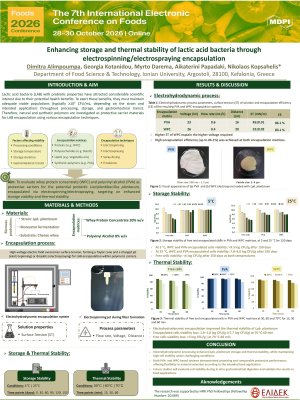
Alimpoumpa et al 2026_7th International Electronic Conference on Foods_poster presentation F.pdf
Engineering Biopolymer Hydrogels for 3D/4D Food Printing in Personalized Nutrition for Elderly Dysphagia Management
Grape Antioxidant Dietary Fibre Enhances Nrf2-Linked Redox Protection in Rat Colonic Mucosa