Event submissions
Published
This submission belongs to the session B. Nutritional & Functional Foods of the event The 7th International Electronic Conference on Foods
Published date
23 Oct, 2026
Academic Editor
 Manuel Viuda-Martos
Citation
Bárbara Sarrión, Marina Hernández-Martín, Silvina Rosa Drago, Mª Elvira López-Oliva, Grape Antioxidant Dietary Fibre Enhances Nrf₂-Linked Redox Protection in Rat Colonic Mucosa, in Proceedings of The 7th International Electronic Conference on Foods, 28 October–30 October 2026, MDPI: Basel, Switzerland
Share
Email
Facebook
Twitter
LinkedIn
Grape Antioxidant Dietary Fibre Enhances Nrf2-Linked Redox Protection in Rat Colonic Mucosa

Bárbara Sarrión 1,2
Marina Hernández-Martín 1,3
Silvina Rosa Drago 4
Mª Elvira López-Oliva 1,3
1. Department of Physiology. Pharmacy School. Complutense University of Madrid, 28040 Madrid, Spain
2. Ramon y Cajal Health Research Institute (IRYCIS), Ramón y Cajal University Hospital, Madrid, Spain.
3. Health Research Institute of the San Carlos Clinical Hospital (IdISSC), 28040 Madrid, Spain
4. Institute of Food Technology (ITA), Faculty of Chemical Engineering, Universidad Nacional del Litoral (FIQ-UNL), National Scientific and Technical Research Council (CONICET), Santa Fe, Argentina.
Abstract
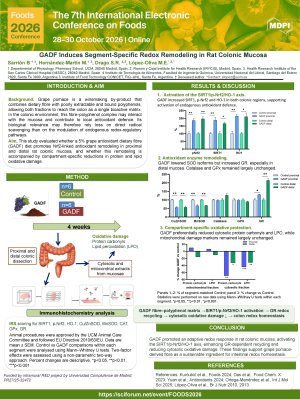
Introduction. Grape pomace combines dietary fibre with poorly extractable and bound polyphenols that can reach the large intestine as a fibre–polyphenol bioactive matrix. This study evaluated whether a 5% grape antioxidant dietary fibre (GADF) diet promotes Nrf2-linked antioxidant remodelling in proximal and distal rat colonic mucosa.
Methods. Male Wistar rats were fed a control diet with or without 5% GADF supplementation for four weeks. Proximal and distal colonic mucosa were analysed for SIRT1,p-Nrf2 (ser40), HO-1, Cu/ZnSOD, MnSOD, catalase, GPx and GR by immunohistochemistry. In addition, protein carbonyls and lipid peroxidation were measured in cytosolic and mitochondrial mucosal fractions to determine the extent of cellular oxidative damage. Statistical comparisons were performed using Mann–Whitney U tests; percent changes are descriptive.
Results and Discussion. GADF increased p-Nrf2 in proximal and distal mucosa by 86% and 96%, respectively (p<0.005), while HO-1 increased by approximately 110% in both regions (p=0.005 and p=0.02). SIRT1 also increased, supporting activation of the SIRT1/p-Nrf2/HO-1 axis. Concurrently, Cu/ZnSOD and MnSOD decreased significantly in both segments (p<0.01), which may reflect reduced superoxide radical pressure, whereas catalase and GPx showed no significant changes. GR increased most markedly in distal mucosa (+114%, p=0.004), suggesting reinforcement of glutathione-dependent redox recycling. Accordingly, cytosolic oxidative damage was reduced, with lower protein carbonyls in proximal (-69%, p=0.0002) and distal mucosa (-33%, p=0.03), and reduced cytosolic lipid peroxidation in both regions (-44%, p=0.005; -32%, p=0.006). Mitochondrial damage markers showed limited changes.
Conclusions. Dietary supplementation with GADF promoted segment-specific redox remodelling in rat colonic mucosa by combining Nrf2-linked signalling, GR-dependent recycling and preferential cytosolic protection. These findings support grape pomace-derived fibre as a sustainable functional ingredient for intestinal redox homeostasis.
Keywords
grape pomace
antioxidant dietary fibre
colonic mucosa
Nrf2
oxidative stress
redox homeostasis.
Poster
GADF_Foods2026_redox_poster.pdf
Enhancing storage and thermal stability of lactic acid bacteria through electrospinning/electrospraying encapsulation
Effect of Yacon Flour and Allulose on the Browning Index and Antioxidant Capacity of Cookies