Event submissions
Published
This submission belongs to the session B. Nutritional & Functional Foods of the event The 7th International Electronic Conference on Foods
Published date
23 Oct, 2026
Academic Editor
 Manuel Viuda-Martos
Citation
Marianela Alejandra Federik, María Noel Zalazar, Lorena Elizabeth Taborda, María Fernanda Gliemmo, Effect of Yacon Flour and Allulose on the Browning Index and Antioxidant Capacity of Cookies, in Proceedings of The 7th International Electronic Conference on Foods, 28 October–30 October 2026, MDPI: Basel, Switzerland
Share
Email
Facebook
Twitter
LinkedIn
Effect of Yacon Flour and Allulose on the Browning Index and Antioxidant Capacity of Cookies

Marianela Alejandra Federik 1
María Noel Zalazar 1
Lorena Elizabeth Taborda 1
María Fernanda Gliemmo 2,3
1. Novel Foods and Nutrition Research Laboratory, Universidad Nacional de Hurlingham, Buenos Aires, B1688AXC, Argentina
2. Institute of Food Technology and Chemical Processes, Faculty of Exact and Natural Sciences, University City, National Scientific and Technical Research Council, Buenos Aires, C1428EGA, Argentina
3. Industries Department, Faculty of Exact and Natural Sciences, University City, Universidad de Buenos Aires, Buenos Aires, C1428EGA, Argentina
Abstract
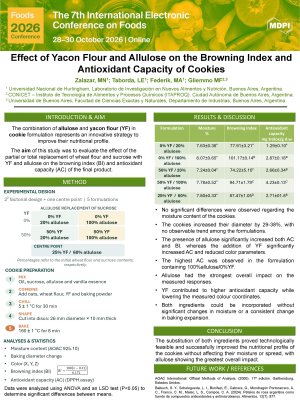
The combination of allulose and yacon flour (YF) in cookie formulation represents an innovative strategy to improve their nutritional profile. The aim of this study was to evaluate the effect of the partial or total replacement of wheat flour and sucrose with YF and allulose on the browning index (BI) and antioxidant capacity (AC) of the final product.
A 2² factorial design with a center point was applied. The factors and their levels were YF content (0-25-50% of the wheat flour content) and allulose content (20-60-100% of the sucrose content), yielding 5 formulations. For the preparation, oil, sucrose, allulose, and vanilla extract were mixed until a homogeneous blend was obtained. Then, oats, wheat flour, YF, and baking powder were incorporated. The dough was cooled at 5±1°C for 30 minutes. It was then cut into circles (26 mm diameter, 10 mm thick), which were baked at 160±1°C for 8 minutes. Subsequently, moisture content, diameter change after baking, AC, and color parameters (L*, a*, b*) were evaluated for all formulations; the latter was used to calculate the BI. Data were analyzed using ANOVA and an LSD test (P<0.05) to determine significant differences between means.
No significant differences were observed regarding the moisture content of the cookies, which averaged 7.63±0.63%. The cookies increased their diameter by 29-38%, with no observable trend among the formulations. The presence of allulose significantly increased both AC and BI, whereas the addition of YF significantly increased AC and reduced color parameters. The highest AC (4.23±0.13 mg Trolox/g dw) was observed in the formulation containing 100%allulose/0%YF.
The substitution of both ingredients proved technologically feasible and successfully improved the nutritional profile of the cookies without affecting their moisture or spread, with allulose having the greatest overall impact.
Keywords
allulose
antioxidant capacity
browning index
cookies
yacon.
Poster
Zalazar et al.pdf
Grape Antioxidant Dietary Fibre Enhances Nrf2-Linked Redox Protection in Rat Colonic Mucosa
What’s in Your Coffee? Ten Years of RASFF Safety Notifications