Event submissions
Published
This submission belongs to the session G. Food Safety, Toxicology & Quality of the event The 7th International Electronic Conference on Foods
Published date
23 Oct, 2026
Academic Editor
 Esther Sendra
Citation
Una Gajic, Dunja Kobiljski, Ljilja Torovic, What’s in Your Coffee? Ten Years of RASFF Safety Notifications, in Proceedings of The 7th International Electronic Conference on Foods, 28 October–30 October 2026, MDPI: Basel, Switzerland
Share
Email
Facebook
Twitter
LinkedIn
What’s in Your Coffee? Ten Years of RASFF Safety Notifications

Una Gajic 1
Dunja Kobiljski 2

Ljilja Torovic 1
1. Department of Pharmacy, Faculty of Medicine, University of Novi Sad, 21000 Novi Sad, Serbia
2. Department of Industrial Engineering and Management, Faculty of Technical Sciences, University of Novi Sad, Novi Sad 21000, Serbia
Abstract
Coffee is one of the most extensively traded agricultural commodities worldwide, and its complex production and distribution chain may introduce diverse chemical and biological hazards.
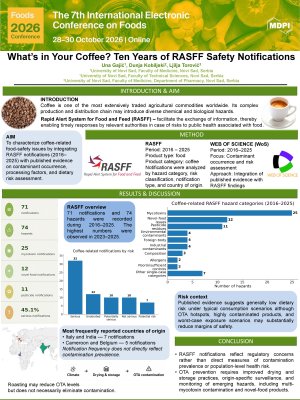
This study integrated coffee-related notifications from the European Union Rapid Alert System for Food and Feed (RASFF) for 2016–2025 with published evidence on contaminant occurrence, agricultural and processing factors, and dietary risk assessment to provide a more comprehensive characterization of coffee safety.
Seventy-one RASFF notifications were identified, with the highest annual numbers recorded during 2023–2025. Mycotoxins were the predominant hazard category (25 notifications), exclusively involving ochratoxin A (OTA), followed by novel food-related issues (12) and pesticide residues (11). Nearly half (45.1%) of notifications were classified as serious. However, notification numbers varied considerably among countries of origin and should not be interpreted directly as measures of contamination prevalence or consumer risk because they are influenced by trade volumes and surveillance intensity. Integration with published evidence identified OTA as the principal contaminant of concern, with occurrence strongly influenced by geographical, climatic, drying, and storage conditions. Although roasting can reduce OTA and pesticide residues, contamination is not eliminated. Recent risk assessments generally indicate low dietary concern for OTA and pesticide residues under typical coffee-consumption scenarios; nevertheless, localized OTA contamination hotspots, highly contaminated products, and worst-case exposure scenarios may substantially reduce margins of safety. Emerging multi-mycotoxin contamination and novel-food products introduce additional surveillance priorities.
Overall, RASFF data are most informative when interpreted alongside trade patterns, occurrence and exposure evidence rather than as direct indicators of health risk. Risk management should prioritize origin- and hazard-specific surveillance, improved drying and storage practices for OTA prevention, multi-mycotoxin monitoring, and targeted control of pesticide non-compliance and emerging novel-food products.
Keywords
public health
food safety
mycotoxins
Poster
Foods poster Coffee.pdf
Effect of Yacon Flour and Allulose on the Browning Index and Antioxidant Capacity of Cookies
Impact of Inonotus hispidus supplementation on morphometric and physiological parameters in HPV16-transgenic mice