Event submissions
Published
This submission belongs to the session B. Nutritional & Functional Foods of the event The 7th International Electronic Conference on Foods
Published date
23 Oct, 2026
Academic Editor
 Manuel Viuda-Martos
Citation
Ana Carla Fortunato, Catarina Medeiros, Tiago Azevedo, Tiago Ferreira, Elisabete Nascimento-Gonçalves, El Hadi Erbiai, Maria João Pires, Margarida MSM Bastos, Rui Medeiros, Ana I. Faustino-Rocha, Rui M. Gil da Costa, Luís Félix, Guilhermina Marques, Maria de Lurdes Pinto, Paula A. Oliveira, Impact of Inonotus hispidus supplementation on morphometric and physiological parameters in HPV16-transgenic mice, in Proceedings of The 7th International Electronic Conference on Foods, 28 October–30 October 2026, MDPI: Basel, Switzerland
Share
Email
Facebook
Twitter
LinkedIn
Impact of Inonotus hispidus supplementation on morphometric and physiological parameters in HPV16-transgenic mice

Ana Carla Fortunato 1
Catarina Medeiros 1

Tiago Azevedo 1,2
Tiago Ferreira 1
Elisabete Nascimento-Gonçalves 1

El Hadi Erbiai 1
Maria João Pires 1
Margarida MSM Bastos 3

Rui Medeiros 4,5,6,7,8

Ana I. Faustino-Rocha 1,9,10

Rui M. Gil da Costa 1,3,4,11,12

Luís Félix 1
Guilhermina Marques 1
Maria de Lurdes Pinto 2

Paula A. Oliveira 1
1. Centre for the Research and Technology of Agro-Environmental and Biological Sciences (CITAB), Institute for Innovation, Capacity Building and Sustainability of Agri-Food Production (Inov4Agro), University of Trás-os-Montes and Alto Douro (UTAD), 5000-801 Vila Real, Portugal
2. Animal and Veterinary Research Centre (CECAV), Associate Laboratory for Animal and Veterinary Sciences (AL4AnimalS), University of Trás-os-Montes and Alto Douro, 5000-801 Vila Real, Portugal
3. Laboratory for Process Engineering, Environment, Biotechnology and Energy (LEPABE), Associate Laboratory in Chemical Engineering (ALiCE), Faculty of Engineering, University of Porto, 4200-465 Porto, Portugal
4. Molecular Oncology and Viral Pathology Group, Research Center of IPO-Porto (CI-IPOP) & RISE@CI-IPOP (Health Research Network), Portuguese Oncology Institute of Porto (IPO-Porto)/Porto Comprehensive Cancer Center Raquel Seruca (Porto.CCC), 4200-072 Porto, Portugal
5. ICBAS—Instituto de Ciências Biomédicas Abel Salazar, University of Porto, 4050-313 Porto, Portugal
6. European Cancer Organisation (ECO), 1040 Brussels, Belgium
7. Faculty of Health Sciences, Fernando Pessoa University, 4200-150 Porto, Portugal
8. Research Department, Portuguese League Against Cancer (NRNorte), 4200-172 Porto, Portugal
9. School of Sciences and Technology, Department of Zootechnics, University of Évora, 7004-516 Évora, Portugal
10. Comprehensive Health Research Center (CHRC), University of Évora, 7004-516 Évora, Portugal
11. Research Center for Experimental and Clinical Physiology and Pharmacology (NEC), Federal University of Maranhão (UFMA), São Luís 65080-805, Brazil
12. Department of Pathology, State University of Maranhão, São Luís 65055-310, Brazil
Abstract
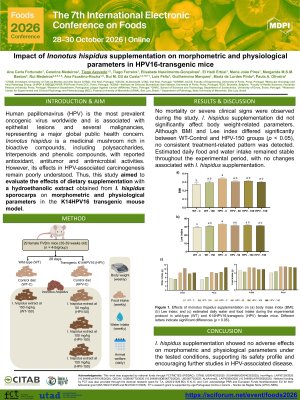
Human papillomavirus (HPV) is the most prevalent oncogenic virus worldwide and is associated with epithelial lesions and several malignancies, representing a major global public health concern. Inonotus hispidus is a medicinal mushroom rich in bioactive compounds, including polysaccharides, triterpenoids and phenolic compounds, with reported antioxidant, antitumor and antimicrobial activities. However, its effects in HPV-associated carcinogenesis remain poorly understood. Thus, this study aimed to evaluate the effects of dietary supplementation with a hydroethanolic extract obtained from I. hispidus sporocarps on morphometric and physiological parameters in the K14HPV16 transgenic mouse model.
Twenty-nine female FVB/n mice (35-39 weeks old), including wild-type (WT) and transgenic K14HPV16 (HPV) animals, were randomly assigned to six groups (n = 4–5/group). Control groups received the standard diet, whereas supplemented groups received diets containing I. hispidus extract at 50, 100, or 150 mg/kg for 28 consecutive days. HPV mice were assigned to HPV-Control, HPV-50, HPV-100, and HPV-150, whereas WT animals were assigned to WT-Control and WT-150. Animal welfare was monitored daily, and body weight, food, and water intake were recorded weekly. Body mass index (BMI) and Lee index were calculated from morphometric measurements. All procedures were conducted in accordance with Directive 2010/63/EU and approved by the relevant national authorities (approval no. 014139).
No mortality or severe clinical signs were observed during the study. I. hispidus supplementation did not significantly affect body weight-related parameters. Although BMI and Lee index differed significantly between WT-Control and HPV-150 groups (p < 0.05), no consistent treatment-related pattern was detected. Estimated daily food and water intake remained stable throughout the experimental period, with no changes associated with I. hispidus supplementation.
In conclusion, I. hispidus supplementation showed no adverse effects on morphometric and physiological parameters under the tested conditions, supporting its safety profile and encouraging further studies in HPV-associated disease.
Keywords
Body weight
BMI
dietary supplementation
Inonotus hispidus
K14HPV16
Lee index
transgenic mice.
Poster
Inonotus Foods 2026.pdf
What’s in Your Coffee? Ten Years of RASFF Safety Notifications
Physicochemical, nutritional, and sensory characteristics of soy- and lentil-based patties analogous to meat