Event submissions
Published
This submission belongs to the session G. Food Safety, Toxicology & Quality of the event The 7th International Electronic Conference on Foods
Published date
23 Oct, 2026
Academic Editor
 Esther Sendra
Citation
Milica Vidić, Emilia Gligorić, Ljilja Torović, Hoodia gordonii as an unauthorised novel food in food products: A RASFF-based analysis, in Proceedings of The 7th International Electronic Conference on Foods, 28 October–30 October 2026, MDPI: Basel, Switzerland
Share
Email
Facebook
Twitter
LinkedIn
Hoodia gordonii as an unauthorised novel food in food products: A RASFF-based analysis

Milica Vidić 1
Emilia Gligorić 1

Ljilja Torović 1
1. Department of Pharmacy, Faculty of Medicine, University of Novi Sad, Hajduk Veljkova 3, 21000 Novi Sad, Serbia
Abstract
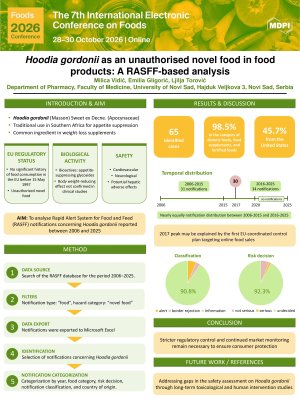
Hoodia gordonii (Masson) Sweet ex Decne. (Apocynaceae) has traditionally been used in Southern Africa to suppress appetite, which explains its frequent inclusion in weight-loss supplements. Due to the absence of a significant history of consumption as food in the European Union (EU) before 15 May 1997, H. gordonii is considered a novel food, but it has not been authorised for use on the EU market. Although a significant body weight-reducing effect has not been confirmed in clinical studies, cardiovascular and neurological adverse effects have been reported.
To evaluate the occurrence of H. gordonii in food products, data from the Rapid Alert System for Food and Feed (RASFF) database for the period 2006–2025 were analysed using “food” as the notification type and “novel food” as the hazard category.
A total of 65 cases concerning H. gordonii were identified. The notifications were nearly equally distributed across the two decades. The prominent peak in 2017 (30 cases) may be explained by the first EU-coordinated control plan targeting online food sales, during which four unauthorised novel foods, including H. gordonii, were specifically monitored. No notifications were recorded from 2020 onwards. Most cases (98.5%) were reported in the category of dietetic foods, food supplements, and fortified foods. The products mainly originated from the United States (45.7%) and the United Kingdom (17.1%). Information notifications accounted for the majority of cases (90.8%). Moreover, undecided risk decisions predominated (92.3%).
Therefore, the occurrence of this unauthorised novel food in food products, despite reported adverse effects associated with its use, highlights the need for stricter regulatory control and continued market monitoring to ensure consumer protection.
Keywords
Hoodia gordonii
Novel food
Food safety
Public health
Poster
Hoodia gordonii.pdf
Proteomic reprogramming during amaranth seed germination reveals a domestication signature associated with stress versus growth strategies
Valorisation of oyster mushroom stems in meat formulations: Effects on physicochemical, technological and sensory properties