Event submissions
Published
This submission belongs to the session B. Nutritional & Functional Foods of the event The 7th International Electronic Conference on Foods
Published date
23 Oct, 2026
Academic Editor
 Manuel Viuda-Martos
Citation
Rui Dias-Costa, Márcio Moura-Alves, Maria José Alves, Cristina Saraiva, Juliana Garcia, Irene Gouvinhas, Valorisation of oyster mushroom stems in meat formulations: Effects on physicochemical, technological and sensory properties, in Proceedings of The 7th International Electronic Conference on Foods, 28 October–30 October 2026, MDPI: Basel, Switzerland
Share
Email
Facebook
Twitter
LinkedIn
Valorisation of oyster mushroom stems in meat formulations: Effects on physicochemical, technological and sensory properties

Rui Dias-Costa 1

Márcio Moura-Alves 2,3
Maria José Alves 4,5,6

Cristina Saraiva 3,7

Juliana Garcia 1,4,5

Irene Gouvinhas 7,8
1. Centre for the Research and Technology of Agroenvironmental and Biological Sciences, CITAB, Inov4Agro, Universidade de Trás-os-Montes e Alto Douro, UTAD, Quinta de Prados, 5000-801 Vila Real, Portugal.
2. Veterinary and Animal Research Centre (CECAV), University of Trás-os-Montes e Alto Douro (UTAD), 5000-801 Vila Real, Portugal
3. Associate Laboratory for Animal and Veterinary Sciences (AL4AnimalS), 1300-477 Lisboa, Portugal
4. AquaValor – Centro de Valorização e Transferência de Tecnologia da Água – Associação, Rua Dr. Júlio Martins n.º 1, 5400-342 Chaves, Portugal.
5. LiveWell - Research Centre for Active Living & Wellbeing, Instituto Politécnico de Bragança, 5300-253 Bragança, Portugal.
6. CIMO - Centro de Investigação de Montanha, Instituto Politécnico de Bragança, 5300-253 Bragança, Portugal.
7. Veterinary and Animal Research Centre (CECAV), University of Trás-os-Montes e Alto Douro (UTAD), 5000-801 Vila Real, Portugal.
8. Associate Laboratory for Animal and Veterinary Sciences (AL4AnimalS), 1300-477 Lisboa, Portugal.
Abstract
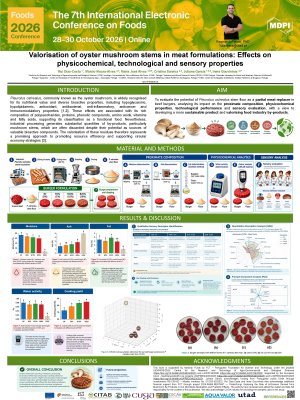
Pleurotus ostreatus, commonly known as the oyster mushroom, is widely valued for its nutritional and functional properties [1]. However, mushroom processing generates considerable amounts of stems, which are often discarded despite their potential as value-added food ingredients [2,3]. This study evaluated the incorporation of oyster mushroom stem flour as a functional ingredient in beef burgers. Four formulations were prepared: a control burger (CB) and burgers containing five percent (B5%), ten percent (B10%), and twenty percent (B20%) mushroom stem flour, based on meat weight.
Physicochemical, colour, technological, and sensory properties were assessed through moisture, ash content, pH, water activity, CIELab colour parameters, cooking yield, descriptive sensory analysis, and purchase intention testing. Mushroom stem flour significantly affected the physicochemical characteristics of the burgers. Moisture content decreased progressively from 72.84 in CB to 70.20, 66.88, and 62.47 in B5%, B10%, and B20%, respectively. In contrast, ash content increased from 1.91 in the control to 2.66 in B20%, suggesting an increase in mineral constituents derived from mushroom stem flour.
A slight increase in pH was observed, while water activity remained stable across formulations. Colour parameters were also affected, particularly at the highest incorporation level, which increased lightness and yellowness while reducing redness. This resulted in a lighter and more yellow product, with a reduced characteristic beef colour. Cooking yield improved with increasing mushroom flour incorporation, rising from 70.69% in the control to 77.76%, 81.71%, and 82.97% in B5%, B10%, and B20%, respectively.
Sensory analysis showed increased mushroom-related attributes as flour incorporation increased, while undesirable attributes remained low. However, purchase intention decreased with higher substitution levels, with B5% showing the highest acceptance among enriched formulations. Overall, oyster mushroom stem flour can be successfully incorporated into beef burgers, improving technological performance and contributing to the valorisation of mushroom-processing by-products. The five percent incorporation level provided the best balance between improved cooking yield and consumer acceptance, supporting its use in more sustainable meat products.
Keywords
Oyster mushroom
mushroom by-products
meat product reformulation
valorisation
Poster
Poster_7th_Foods_CConference_RUICOSTA.pdf
Hoodia gordonii as an unauthorised novel food in food products: A RASFF-based analysis
KNOWLEDGE, ATTITUDES, AND PRACTICES OF FOOD INDUSTRY PROFESSIONALS TOWARD RABBIT MEAT IN FILIPINO CUISINE