Event submissions
Published
This submission belongs to the session E. Sustainable Food System & Food Security of the event The 7th International Electronic Conference on Foods
Published date
23 Oct, 2026
Academic Editor
 Bimal Chitrakar
Citation
Adrian Paul Hinalao Basilio, Ephraimuel Jose Abellana, KNOWLEDGE, ATTITUDES, AND PRACTICES OF FOOD INDUSTRY PROFESSIONALS TOWARD RABBIT MEAT IN FILIPINO CUISINE, in Proceedings of The 7th International Electronic Conference on Foods, 28 October–30 October 2026, MDPI: Basel, Switzerland
Share
Email
Facebook
Twitter
LinkedIn
KNOWLEDGE, ATTITUDES, AND PRACTICES OF FOOD INDUSTRY PROFESSIONALS TOWARD RABBIT MEAT IN FILIPINO CUISINE

Adrian Paul Hinalao Basilio 1
Ephraimuel Jose Abellana 2
1. Department of Food Science and Nutrition, University of the Philippines, Diliman, Quezon City, Philippines
2. School of Hospitality Management, Philippine Women's University, Manila City, 1004, Philippines
Abstract
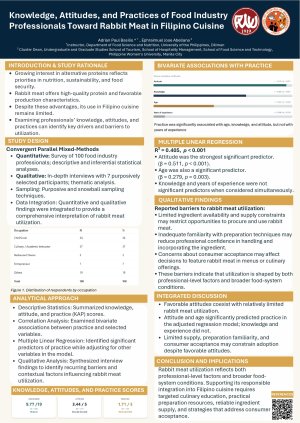
The growing emphasis on sustainable food systems has increased interest in alternative protein sources that address nutrition, environmental sustainability, and food security. Rabbit meat offers high-quality protein and favorable production characteristics, yet its integration into Filipino culinary practice remains limited. This study examined the knowledge, attitudes, and practices (KAP) of food industry professionals regarding rabbit meat utilization in Filipino cuisine and identified factors associated with its use.
Using a mixed-methods research design, the study involved 100 food industry professionals, including chefs, culinary educators, restaurant practitioners, food service managers, and other professionals engaged in food preparation, production, management, and culinary instruction. Quantitative data were collected through a structured KAP survey, while qualitative data were obtained through focus group discussions and interviews exploring professional experiences, perceptions, and barriers to rabbit meat utilization.
Quantitative findings showed moderate knowledge (M = 9.77, SD = 4.62), generally favorable attitudes (M = 3.44, SD = 1.07), and relatively limited utilization in culinary practice (M = 1.71, SD = 1.03). Practice was significantly correlated with age (r = 0.261, p = 0.004), knowledge (r = 0.400, p < 0.001), and attitude (r = 0.575, p < 0.001), but not years of experience (r = 0.048, p = 0.318). Multiple linear regression showed that the model significantly explained variation in practice (R² = 0.405, p < 0.001). Attitude was the strongest significant predictor (β = 0.511, p < 0.001), followed by age (β = 0.279, p = 0.003). Knowledge and years of experience were not significant predictors when considered simultaneously.
Qualitative findings identified limited ingredient availability, inadequate familiarity with preparation techniques, supply constraints, and concerns about consumer acceptance as key barriers. Overall, the findings suggest that rabbit meat utilization is shaped not only by individual knowledge and attitudes but also by broader food system conditions. These findings provide a basis for developing targeted educational initiatives, culinary resources, and industry strategies to support the responsible, sustainable, and culturally appropriate integration of rabbit meat into Filipino cuisine.
Keywords
Keywords: alternative protein
Filipino cuisine
knowledge–attitude–practice
mixed methods
rabbit meat
Poster
Basilio_Knowledge, Attitudes, and Practices of Food Industry Professionals Toward Rabbit Meat in Filipino Cuisine.pdf
Valorisation of oyster mushroom stems in meat formulations: Effects on physicochemical, technological and sensory properties
Eurycoma longifolia (Tongkat Ali) as an unauthorised novel food in food products: An overview of RASFF notifications