Event submissions
Published
This submission belongs to the session G. Food Safety, Toxicology & Quality of the event The 7th International Electronic Conference on Foods
Published date
23 Oct, 2026
Academic Editor
 Esther Sendra
Citation
Milica Vidić, Emilia Gligorić, Ljilja Torović, Eurycoma longifolia (Tongkat Ali) as an unauthorised novel food in food products: An overview of RASFF notifications, in Proceedings of The 7th International Electronic Conference on Foods, 28 October–30 October 2026, MDPI: Basel, Switzerland
Share
Email
Facebook
Twitter
LinkedIn
Eurycoma longifolia (Tongkat Ali) as an unauthorised novel food in food products: An overview of RASFF notifications

Milica Vidić 1
Emilia Gligorić 1

Ljilja Torović 1
1. Department of Pharmacy, Faculty of Medicine, University of Novi Sad, Hajduk Veljkova 3, 21000 Novi Sad, Serbia
Abstract
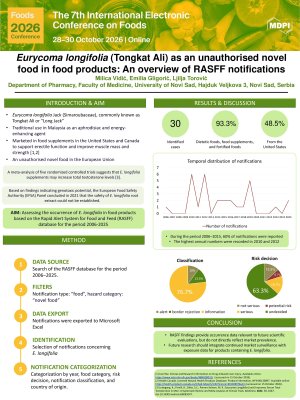
Eurycoma longifolia Jack (Simaroubaceae), commonly known as Tongkat Ali, has traditionally been used in Malaysia as an aphrodisiac and energy-enhancing agent. Despite its status as an unauthorised novel food in the European Union, E. longifolia is commonly found in male-targeted food supplements, where it is promoted for supporting erectile function and improving muscle mass and strength. Additionally, based on findings indicating genotoxic potential, the European Food Safety Authority (EFSA) Panel concluded in 2021 that the safety of E. longifolia root extract could not be established. Therefore, the present study aimed to assess the occurrence of E. longifolia in food products based on the Rapid Alert System for Food and Feed (RASFF) database.
RASFF data were retrieved for the period 2006–2025 using “food” as the notification type and “novel food” as the hazard category, resulting in 30 relevant cases. Most notifications were reported during 2006–2015 (60%), with the highest annual numbers recorded in 2010 and 2012 (6 cases). Another notable increase was recorded in 2019 (5), followed by a decline and no notifications reported in 2020–2022 or 2024. Dietetic foods, food supplements and fortified foods were the main food categories in which E. longifolia was reported (93.3%). The United States was the most common country of origin (48.5%), followed by Malaysia and the Netherlands (9.1% each). Information notifications predominated (76.7%), followed by border rejections (13.3%) and alerts (10%). Risk decisions were mainly classified as undecided (63.3%) and serious (16.7%).
These findings provide additional occurrence data that may be relevant for future scientific evaluations of food products containing E. longifolia. However, RASFF notifications do not represent a direct measure of market prevalence. Therefore, future research may build upon these findings through continued monitoring and integration of market surveillance and exposure data on E. longifolia occurrence.
Keywords
Eurycoma longifolia
Novel food
Food safety
Public health
Poster
Eurycoma longifolia.pdf
KNOWLEDGE, ATTITUDES, AND PRACTICES OF FOOD INDUSTRY PROFESSIONALS TOWARD RABBIT MEAT IN FILIPINO CUISINE
Essential Fatty Acids and Human Health Indexes in Gilthead sea bream (Sparus aurata): Evaluating Sustainable Feed Alternatives and growing stage