Event submissions
Published
This submission belongs to the session G. Food Safety, Toxicology & Quality of the event The 7th International Electronic Conference on Foods
Published date
23 Oct, 2026
Academic Editor
 Arun K Bhunia
Citation
Isabel Casanova Martínez, Marina Cano-Lamadrid, Angel Antonio Carbonell-Barrachina, Esther Sendra, Essential Fatty Acids and Human Health Indexes in Gilthead sea bream (Sparus aurata): Evaluating Sustainable Feed Alternatives and growing stage, in Proceedings of The 7th International Electronic Conference on Foods, 28 October–30 October 2026, MDPI: Basel, Switzerland
Share
Email
Facebook
Twitter
LinkedIn
Essential Fatty Acids and Human Health Indexes in Gilthead sea bream (Sparus aurata): Evaluating Sustainable Feed Alternatives and growing stage

Isabel Casanova Martínez 1

Marina Cano-Lamadrid 1
Angel Antonio Carbonell-Barrachina 1

Esther Sendra 1
1. Instituto de Investigación e Innovación Agroalimentaria y Agroambiental(CIAGRO-UMH). Universidad Miguel Hernández de Elche. Ctra Beniel, Km 3.2, 03312 Orihuela (Alicante), Spain.
Abstract
Introduction: The development of sustainable aquaculture feeds is a key challenge for modern aquaculture, particularly with regard to replacing fish meal and fish oil with alternative ingredients without compromising fish performance or nutritional quality. Particular attention has been paid to maintaining adequate levels of essential fatty acids, which are critical both for fish physiology and for the nutritional value of aquaculture products intended for human consumption.
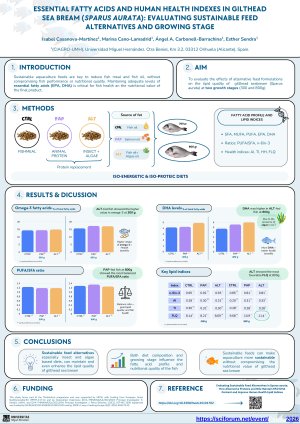
Objective: Consequently, this study evaluated the effects of alternative feed formulations on the lipid quality of gilthead seabream (Sparus aurata) at two growth stages (300 and 800 g body weight).
Methods: Three iso-energetic and iso-proteic diets were tested: a fishmeal-based control (CTRL), a processed animal protein-based diet (PAP), and an alternative protein-rich diet including insect and algae (ALT). Each diet was administered with varying pellet sizes adapted to the fish’s developmental stage. Fatty acid profiles (SFA, MUFA, PUFA, EPA, SHA),fatty acid ratios and health-related lipid indices (PUFA/SFA, n-6/n-3, AI, TI, HH, FLQ) were assessed in fillet samples.
Results and discussion: Results showed that at 300 g fillets, fish fed the ALT diet were richer in omega-3 fatty acids, DHA levels was highest in ALT-fed fish at 800 g. However, PAP-fed fish at 800 g showed the most balanced PUFA/SFA ratio.
Conclusions: These findings demonstrate the viability of sustainable feed alternatives for maintaining the nutritional quality of gilthead sea bream. The study also shows that both diet composition and growth stage influence the fatty acid profile and nutritional quality of the fish. Therefore, sustainable feed alternatives can support aquaculture sustainability while preserving nutritional value across different production stages.
Keywords
DHA (docosahexaenoic acid)
EPA (eicosapentaenoic acid)
protein source
omega-3
fish oil.
Poster
Poster Foods 2026_ICM.pdf
Eurycoma longifolia (Tongkat Ali) as an unauthorised novel food in food products: An overview of RASFF notifications
Current Status of Texture-Modified Transitional Foods for Infants: A Scoping Review and Spanish Market Analysis