Event submissions
Published
This submission belongs to the session G. Food Safety, Toxicology & Quality of the event The 7th International Electronic Conference on Foods
Published date
23 Oct, 2026
Academic Editor
 Arun K. Bhunia
Citation
Ágata García-Nácher, Ana M. Solivella-Poveda, Marina Cano-Lamadrid, Esther Sendra, Current Status of Texture-Modified Transitional Foods for Infants: A Scoping Review and Spanish Market Analysis, in Proceedings of The 7th International Electronic Conference on Foods, 28 October–30 October 2026, MDPI: Basel, Switzerland
Share
Email
Facebook
Twitter
LinkedIn
Current Status of Texture-Modified Transitional Foods for Infants: A Scoping Review and Spanish Market Analysis

Ágata García-Nácher 1
Ana M. Solivella-Poveda 1

Marina Cano-Lamadrid 1

Esther Sendra 1
1. Instituto de Investigación e Innovación Agroalimentaria y Agroambiental (CIAGRO-UMH), Universidad Miguel Hernández, 03312, Alicante, Spain
Abstract
Introduction
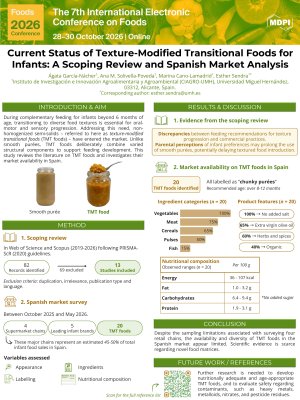
During complementary feeding for infants beyond 6 months of age, transitioning to diverse food textures is essential for oral-motor and sensory progression. Addressing this need, non-homogenized semi-solids – referred to here as texture-modified transitional foods (TMT foods) – have entered the market. Unlike smooth purées, TMT foods deliberately combine varied structural components to support feeding development. This study reviews the literature on TMT foods and investigates their market availability in Spain.
Methods
Following PRISMA-ScR (2020) guidelines, a scoping review in Web of Science and Scopus (2019-2026) included 13 of 82 identified records, excluding 69 due to duplication, irrelevance, publication type or language. Additionally, a Spanish market survey assessed appearance, ingredients, nutritional composition, and labelling of 20 TMT foods from five leading infant brands across four supermarket chains, representing an estimated 45-50% of total infant food sales, between October 2025 and May 2026.
Results and Discussion
The 13 studies revealed discrepancies between feeding recommendations and commercial practice, as smooth purées were often prolonged based on parents’ perceptions of infant preferences, potentially delaying textured food introduction. Only 20 TMT foods were identified, all labelled as “chunky purées” (recommended age: over 8-12 months), indicating limited diversity compared to conventional purées. All contained vegetables (mostly carrot), 75% included meat, 65% cereals, 50% pulses, and 15% fish. Furthermore, 40% were organic, 65% included extra virgin olive oil, and 60% herbs and spices, with no added salt. The energy density was 36-107 kcal/100g, with macronutrients ranging from 1.0-3.2 g fat, 6.4-9.4 g carbohydrates (no added sugar) and 1.9-3.1 g protein per 100g.
Conclusions
Despite the sampling limitations associated with surveying four retail chains, the availability and diversity of TMT foods in the Spanish market appear limited. Scientific evidence is scarce regarding novel food matrices. Further research is needed to develop nutritionally adequate and age-appropriate TMT foods, and to evaluate safety regarding contaminants, such as heavy metals, metalloids, nitrates, and pesticide residues.
Keywords
Complementary feeding
Commercial
Texture
Toddlers
Chunky
Nutritional composition
Poster
Foods2026_Poster.pdf
Essential Fatty Acids and Human Health Indexes in Gilthead sea bream (Sparus aurata): Evaluating Sustainable Feed Alternatives and growing stage
Comparative phenolic composition of Swiss chard and spinach microgreens