Event submissions
Published
This submission belongs to the session B. Nutritional & Functional Foods of the event The 7th International Electronic Conference on Foods
Published date
23 Oct, 2026
Academic Editor
 Manuel Viuda-Martos
Citation
Ana Luísa Monteiro, Márcia Marques, Jean Michel Fernandes, António A. Vicente, Ana C. Pinheiro, Joana T. Martins, Natural Solid Lipid Nanoparticles as an Emerging Platform for Vitamin E Delivery in Functional Foods, in Proceedings of The 7th International Electronic Conference on Foods, 28 October–30 October 2026, MDPI: Basel, Switzerland
Share
Email
Facebook
Twitter
LinkedIn
Natural Solid Lipid Nanoparticles as an Emerging Platform for Vitamin E Delivery in Functional Foods

Ana Luísa Monteiro 1
Márcia Marques 1
Jean Michel Fernandes 1
António A. Vicente 1,2
Ana C. Pinheiro 1,2
Joana T. Martins 1,2
1. CEB - Centre of Biological Engineering, University of Minho, 4710-057 Braga, Portugal
2. LABBELS – Associate Laboratory, University of Minho, Braga, Guimarães, Portugal
Abstract
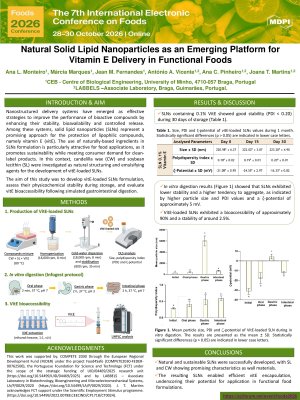
Nanostructured delivery systems have emerged as effective strategies to improve the performance of bioactive compounds by enhancing their stability, bioavailability and controlled release. Among these systems, solid lipid nanoparticles (SLNs) represent a promising approach for the protection of lipophilic compounds, namely vitamin E (vitE). The use of naturally-based ingredients in SLNs formulation is particularly attractive for food applications, as it promotes sustainability while meeting consumer demand for clean-label products. In this context, candelilla wax (CW) and soybean lecithin (SL) were investigated as natural structuring and emulsifying agents for the development of vitE-loaded SLNs.
The aim of this study was to optimize vitE-loaded SLNs formulation, assess their physicochemical stability during storage, and evaluate vitamin E bioaccessibility following simulated gastrointestinal digestion. A Central Composite Rotatable Design (CCRD) was employed to determine the optimal CW and SL concentrations, ranging from 1.5 to 3.0% (w/w). The resulting vitE-loaded SLNs were characterized by particle size, polydispersity index (PDI), z-potential, and morphology evaluation. SLNs stability was monitored over a one-month storage period. To investigate vitE bioaccessibility and stability throughout digestion, the optimized vitE-loaded SLNs were subjected to in vitro digestion using the harmonized INFOGEST protocol.
The optimized vitE-loaded SLNs formulation exhibited mean particle size of approximately 220 nm, z-potential values close to −22 mV, and low PDI values (≈0.180), indicating the formation of homogeneous nanoparticle dispersions. Furthermore, the SLNs maintained their physicochemical integrity throughout one month of storage. Following digestion, vitE stability reached 2.5%, while its bioaccessibility was determined to be close to 90%.
Overall, this work demonstrates the potential of CW and SL as natural and sustainable materials for SLNs production. The developed nanoparticles showed suitable physicochemical properties, storage stability, and promising performance as delivery systems for vitE, supporting their future incorporation into functional food products.
Keywords
Lipid nanoparticles
Candelilla wax
Soybean lecithin
Vitamin E encapsulation
In vitro digestion
Bioaccessibility
Poster
FODDS2026_ poster Joana Martins.pdf
Comparative phenolic composition of Swiss chard and spinach microgreens
Barriers and Opportunities for Valorizing Coffee Pulp as a Functional Food Ingredient in the Dominican Republic: Results from a National Producer Survey