Event submissions
Published
This submission belongs to the session G. Food Safety, Toxicology & Quality of the event The 7th International Electronic Conference on Foods
Published date
23 Oct, 2026
Academic Editor
 Paulo Vale
Citation
Marta Rodríguez-Soriano, Ana M. Solivella-Poveda, Esther Sendra, Marina Cano-Lamadrid, Food Safety in Rice-Based Beverages: Labeling Screening and LAB-Driven Metal(loid) Detoxification Review, in Proceedings of The 7th International Electronic Conference on Foods, 28 October–30 October 2026, MDPI: Basel, Switzerland
Share
Email
Facebook
Twitter
LinkedIn
Food Safety in Rice-Based Beverages: Labeling Screening and LAB-Driven Metal(loid) Detoxification Review

Marta Rodríguez-Soriano 1
Ana M. Solivella-Poveda 1

Esther Sendra 1

Marina Cano-Lamadrid 1
1. Instituto de Investigación e Innovación Agroalimentaria y Agroambiental CIAGRO. Universidad Miguel Hernández de Elche. Ctra Beniel km. 3,2 03312 Orihuela, Alicante, Spain
Abstract
Introduction and aims:
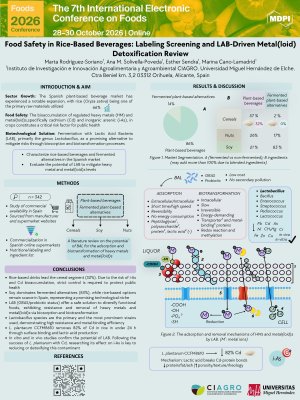
The Spanish plant-based beverage sector represents 66% of market value. Rice (Oryza sativa) represents a strategic raw material tailored to specific dietary needs, including celiacs, lactose-intolerant individuals, athletes, and "veggie" populations. However, its natural accumulation of Cd and i-As poses a critical food safety threat under European regulation (EU) 2023/915. While Lactic Acid Bacteria (LAB) fermentation offers nutritional advantages, current research on rice-based beverages overlooks heavy metal remediation. This study aimed to evaluate the labeling of commercial rice beverages in Spain and, through a literature review, assess the biotechnological potential of LAB starter cultures to reduce metal(oid) bioavailability and modulate arsenic speciation.
Methods: A market screening of 342 plant-based references (295 beverages and 47 fermented alternatives) was conducted. Inclusion criteria required: (1) availability in Spanish online supermarkets, and (2) accessible ingredient lists and mandatory nutritional labelling. Concurrently, a literature review analysed LAB-mediated fermentation of rice beverages and their metal(loid) levels, evaluating starter cultures as a biotechnological strategy to enhance safety.
Results and Discussion: Market analysis revealed cereals lead the beverage category (57%), with rice constituting 32%. Conversely, a major void exists in the fermented segment: soy (83%) and nuts (17%) dominate, whereas cereals are residual (2%), with absence of fermented rice alternatives. Regarding safety, scientific evidence confirms specific LAB strains (mainly Lactobacillus) effectively sequester Cd, Pb, Ni, and methylmercury through cell-wall binding, offering a strategic pathway to alter arsenic speciation toward less toxic forms. Consequently, this lack of fermented rice products in Spain represents a significant technological and market opportunity.
Conclusion: Implementing tailored LAB fermentation serves as a novel dual-purpose industrial strategy: it drives innovation by diversifying the functional food market while enhancing food safety through biotechnological mitigation of dietary toxicological risks.
Keywords
inorganic arsenic
lactic acid bacteria
fermentation
heavy metals
nutritional quality
commercial
Poster
MartaR_Foods poster template.pdf
Barriers and Opportunities for Valorizing Coffee Pulp as a Functional Food Ingredient in the Dominican Republic: Results from a National Producer Survey
Green Technologies for Circular Valorization of Agri-Food Bioresources