Event submissions
Published
This submission belongs to the session B. Nutritional & Functional Foods of the event The 7th International Electronic Conference on Foods
Published date
23 Oct, 2026
Academic Editor
 Manuel Viuda-Martos
Citation
Thivya Nallathamby, Chamodi pamalka, Geethika Savindhi Gammeddegoda Liyanage, Development and Evaluation of a Low Glycemic Index Nutrient Bar made with Finger Millet (Eleusine coracana), Kodo Millet (Paspalum scrobiculatum) and Kithul Palm (Caryota urens) Jaggery as a Natural Sweetener, in Proceedings of The 7th International Electronic Conference on Foods, 28 October–30 October 2026, MDPI: Basel, Switzerland
Share
Email
Facebook
Twitter
LinkedIn
Development and Evaluation of a Low Glycemic Index Nutrient Bar made with Finger Millet (Eleusine coracana), Kodo Millet (Paspalum scrobiculatum) and Kithul Palm (Caryota urens) Jaggery as a Natural Sweetener

Thivya Nallathamby 1
Chamodi pamalka 1
Geethika Savindhi Gammeddegoda Liyanage 1
1. Department of Food Science and Nutrition, Faculty of Life and Medical Sciences, BMS Campus, Colombo , 00600, Sri Lanka
Abstract
The increasing prevalence of metabolic disorders has driven demand for functional snack alternatives with low glycemic index (GI) potential. This study aimed to develop a millet-based nutrient bar using finger millet (Eleusine coracana), kodo millet (Paspalum scrobiculatum), Kithul Palm Jaggery as a natural sweetener, and locally sourced nuts and seeds. The optimized formulation was selected at a 70:30 finger millet to kodo millet ratio from five formulation trials and evaluated for proximate composition, in-vitro starch digestibility, total phenolic content (TPC), total flavonoid content (TFC) and microbiological stability. Sensory acceptability was conducted using a 9-point hedonic scale with 55 untrained panelists. The developed bar was compared with two commercial reference bars from Sri Lanka and the United Kingdom. Data in triplicates were analyzed by one-way ANOVA, followed by Tukey’s HSD test (p<0.05). The developed bar had 433 kcal/100g energy, 13.0g/100g crude protein, 6.13±0.07% moisture, 2.50±0.14% ash, 13.50±0.14% crude fat and 64.8g/100g total carbohydrates. Crude fibre content was <0.1%, possibly due to the use of refined millet. The developed bar had a higher protein content than the UK reference bar (7.0g/100g). In-vitro starch hydrolysis indicated a delayed digestibility peak and lower hydrolysis rate compared with commercial bars, indicating low GI potential. TFC (0.52±0.05 mg QE/g) was significantly lower than the Sri Lankan bar (1.21±0.03mg QE/g) but comparable to the UK bar (0.61±0.02mg QE/g). TPC (0.097±0.00mg GAE/g) was similar to the Sri Lankan bar but significantly lower than the UK bar (0.302±0.00mg GAE/g). Sensory evaluation revealed no significant difference in overall compared with commercial products. A 21-day shelf life was established based on microbiological stability, with total plate counts (9.4×10²CFU/g) and yeast and mould counts (1.8×10²CFU/g) within acceptable limits for low-moisture ready-to-eat foods. Overall, the developed nutrient bar demonstrates potential as a nutritious, consumer-acceptable and a low GI snack.
Keywords
functional snack
high protein
low GI
millet
Poster
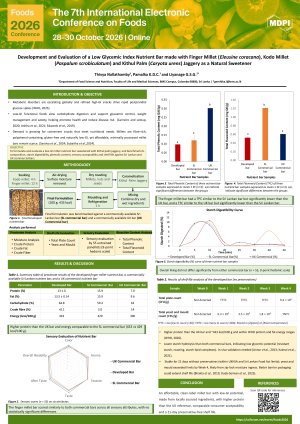
Thivya Nallathamby _ Poster Presentation.pdf
Green Technologies for Circular Valorization of Agri-Food Bioresources
Nutritional composition and antioxidant potential of Talinum paniculatum (Jacq.) Gaertn. seeds