Event submissions
Published
This submission belongs to the session E. Sustainable Food System & Food Security of the event The 7th International Electronic Conference on Foods
Published date
23 Oct, 2026
Academic Editor
 Davide Papurello
Citation
Marcleilton R. S. Santos, Maria Eduarda Cordeiro, Tayse F. F. da Silveira, Marinês P. Corso, Rossana V. C. Cardoso, Lillian Barros, Joana S. Amaral, Nutritional composition and antioxidant potential of Talinum paniculatum (Jacq.) Gaertn. seeds, in Proceedings of The 7th International Electronic Conference on Foods, 28 October–30 October 2026, MDPI: Basel, Switzerland
Share
Email
Facebook
Twitter
LinkedIn
Nutritional composition and antioxidant potential of Talinum paniculatum (Jacq.) Gaertn. seeds

Marcleilton R. S. Santos 1,2
Maria Eduarda Cordeiro 1
Tayse F. F. da Silveira 1
Marinês P. Corso 2
Rossana V. C. Cardoso 1

Lillian Barros 1

Joana S. Amaral 1
1. CIMO, LA SusTEC, Instituto Politécnico de Bragança, Campus de Santa Apolónia, 5300-253 Bragança, Portugal.
2. Departamento Acadêmico de Alimentos, UTFPR, Av. Brasil, 4232, Parque Independência, 85884-000, Medianeira, Brazil.
Abstract
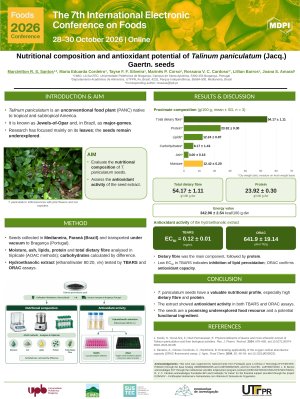
Talinum paniculatum (Jacq.) Gaertn., an unconventional food plant (UFP) native to tropical and subtropical America, is commonly known as jewels-of-opar and as major-gomes in Brazil. In addition to its culinary use, this species is also recognized for its antioxidant, antimicrobial, anti-inflammatory, and diuretic properties. Despite the growing interest in UFPs, studies on T. paniculatum have mainly focused on its leaves, highlighting their nutritional value and bioactive composition, while its seeds remain underexplored. Therefore, this work aimed to evaluate the nutritional composition and antioxidant activity of T. paniculatum seeds. The seeds were collected in Medianeira, Paraná, Brazil (25°17'49.5"S 54°06'51.9"W), and transported under vacuum to Bragança, Portugal (41°47'53.6"N 6°45'56.7"W). Moisture, ash, lipid, protein, and total dietary fiber analyses were performed in triplicate according to AOAC methods, while carbohydrates were calculated by difference. The seeds'hydroethanolic extract (ethanol/water, 80:20, v/v) was evaluated for antioxidant activity using the TBARS and ORAC methods. The seeds showed a moisture content of 12.42 ± 0.20 g/100 g and were particularly rich in total dietary fiber (54.17 ± 1.11 g/100 g dry weight (dw)), followed by proteins (23.92 ± 0.30 g/100 g dw), lipids (12.24 ± 0.87 g/100 g dw), carbohydrates (6.17 ± 1.43 g/100 g dw), and ash (3.00 ± 0.16 g/100 g dw), with an energy value of 342.96 ± 2.54 kcal/100 g dw. The extract demonstrated significant inhibition of lipid peroxidation by the TBARS method (EC₅₀ = 0.12 ± 0.01 mg/mL) and high antioxidant capacity by the ORAC method (641.9 ± 19.14 µmol TE/g). The results demonstrate that T. paniculatum seeds have a valuable nutritional profile, characterized by a particularly high dietary fiber content and marked antioxidant activity, highlighting their potential as a promising underexplored food resource and as a functional ingredient for the development of innovative food products with added nutritional value.
Keywords
Talinum paniculatum
unconventional food plants
seeds
nutritional composition
antioxidant activity
Poster
Poster The 7th IECOF.pdf
Development and Evaluation of a Low Glycemic Index Nutrient Bar made with Finger Millet (Eleusine coracana), Kodo Millet (Paspalum scrobiculatum) and Kithul Palm (Caryota urens) Jaggery as a Natural Sweetener
Recovery of residual oil from canola meal by ultrasound-assisted extraction, using a green solvent: influence of process variables